All on the Line · Capital Cycles
The AI power race won’t be won by the cleanest source or the fastest chip, but by whoever turns clean power into a product first.
The economics of power to compute
2 July 2026
10 minutes
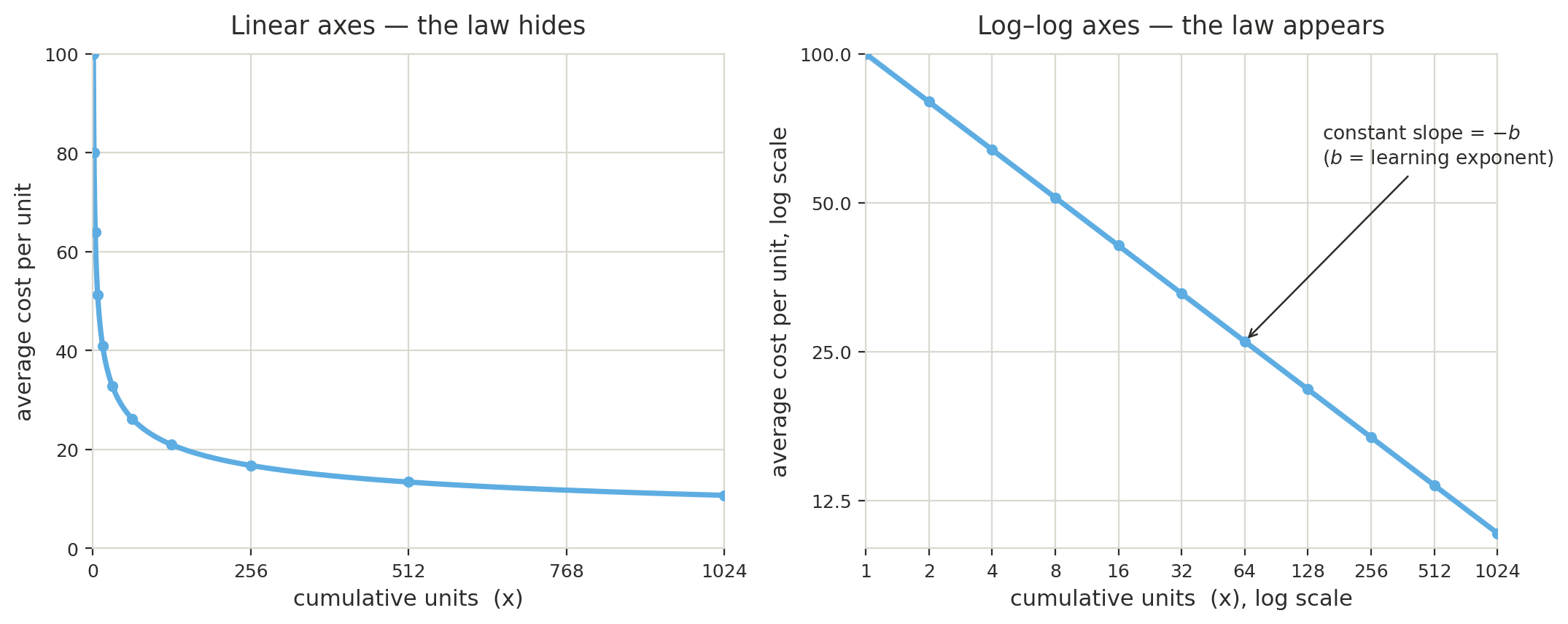
In 1936 an aeronautical engineer named Theodore Wright published a paper on the cost of building airplanes, and noticed something that sounded like accounting trivia and turned out to be a law. Every time the cumulative number of airframes a factory had built doubled, the average labor in each one fell by a roughly constant percentage — around twenty percent. Not twenty percent a year, and not from a bulk discount: twenty percent per doubling of the number of planes ever made. Double the count and the average labor per plane falls to eighty percent of what it was; double it again and it falls to eighty percent of that; by the thousandth — the tenth doubling, since 210 is 1,024 — the cumulative average has fallen to 0.810 ≈ 0.107 of the first: a drop of nearly ninety percent.1
Write the observation down and it stops being trivia. A cost that is cut to a constant fraction every time cumulative output doubles is a power law: the cumulative average cost of the first x units is C(x) = C₁ · x⁻ᵇ, where C₁ is the cost of the first unit and b — about 0.32 for a twenty-percent curve — is the exponent that fixes how steeply the cost falls.2 The only variable on the right-hand side is x, the cumulative count of what you have actually built. Wright measured it in labor, but the same law governs cost. Its shape is easy to miss and easy to confirm: on ordinary axes the constant fraction hides, because the absolute savings shrink as the curve flattens toward the floor, but a logarithmic axis spaces numbers by ratio rather than by amount, so the equal fractional steps straighten into a line whose slope is exactly −b — the proof that the rate really is constant, and not merely fast at first. That line took solar module costs down by the same mechanism, at almost the same slope, for forty years, until the most expensive way to make electricity in 1980 became the cheapest humanity has ever known.3 Lithium-ion batteries followed it a generation later.4 The pattern is old, measured, and indifferent to sentiment.5
The law is also misread, which is why most arguments about the energy transition run in circles. We debate clean against dirty as though that settled which technology wins, when it is a different question entirely. Cleanliness is a fact about a technology’s emissions; the cost curve, a fact about how it is manufactured. The two are perpendicular, and you cannot read who wins from one of them alone.
Hold them apart and the landscape resolves into four quadrants. A technology can be clean or dirty, and independently it can be a product — stamped out by the thousand on a line — or a monument, a bespoke megaproject poured in place one at a time. Solar and batteries sit in the corner that is both clean and product, and that pairing, not their cleanliness alone, is why they won. The proof sits in the opposite clean corner. Gigawatt nuclear is as carbon-free as anything on earth, yet across the decades we built it, it grew more expensive per unit the more we built — most starkly in France, the learning curve running backward because every plant was a fresh monument, re-permitted and re-engineered and poured from scratch.6 Being carbon-free did nothing to bend that curve, because the curve answers to volume, not virtue, and a monument is by definition never built in volume.
That cut — nearly ninety percent of the cost, gone over ten doublings — is a fact about units, not time, which is where Wright’s Law parts from the Moore’s Law people reach for by reflex. Moore’s is a function of the calendar; you wait and the gift arrives. Wright’s is a function of production; it arrives only if you build. A certified design that has shipped nothing sits frozen at the top of its curve no matter how many years pass. The discount is earned in units, and only in units.
Which is why the company currently winning the contest to power artificial intelligence is not a reactor company. It is Bloom Energy, which makes solid-oxide fuel cells and which booked roughly $7.65 billion in data-center contracts in a single ninety-day stretch bridging late 2025 and early 2026, entering the year with a backlog near twenty billion and revenue more than doubling year over year. It is doubling its factory capacity and sliding down its curve in real time, because it is shipping. It also runs, for now, mostly on natural gas — its vulnerability, and the reason a hyperscaler abandoned a plan to power three of its data centers with the cells.7 A compromised, gas-burning source is out in front purely because it can be made and bolted down faster than anything else — and the speed deserves a closer look, because in 2026 speed, not price, is what the buyers are paying for. A data hall full of idle accelerators loses more in a quarter of waiting than it will ever recover on its power bill, so the market clears on the calendar, and the calendar is a manufacturing property: a factory-made unit sits on site, behind the meter, and skips the interconnection queue, its approvals repeat because its design does, and its construction is an installation. Bloom’s standard deployment runs about ninety days, and one recent system was delivered in fifty-five — practice already compressing the calendar, which is fitting, since Wright’s original variable was hours. That is what makes Bloom the clearest proof of how much manufacturing now decides — and, in the same stroke, not the finish line, because the fuel that lets it sprint is what a rising carbon price, or a buyer who will pay more for firm clean power, counts against it.
The finish line is the corner solar and batteries already hold, and the cautionary tale of how hard it is to reach is a company with the promise built into its name. NuScale makes small modular reactors and holds the only such design the American regulator has certified — on paper, the purest expression of the monument-to-product idea in the sector. It has also never sold a commercial unit: its flagship first project was cancelled as first-of-a-kind costs climbed and its subscribers walked, and it has posted losses every quarter since, waiting for an order — in one recent quarter using over three hundred million dollars of operating cash.8 Calling yourself modular is not the same as shipping a module. NuScale is stranded in the valley every manufactured technology has to cross — between the first unit, still priced like a monument, and the number of units at which the curve bends below the alternative. Crossing it is a problem of financing as much as engineering, which is why the roughly five billion dollars Brookfield committed to deploy Bloom’s cells matters: capital that puts units in the field moves the only variable the curve responds to. The one commercial small reactor actually under construction in the Western world, GE-Hitachi’s at Ontario’s Darlington site, crosses by refusing to be pure — it leans on an already-certified design to shorten its path to a first poured unit.9 It is the least purely modular of the designs and the only one whose first unit is being built, which on a learning curve is the distinction that matters, because only built units move the cost down.
The reason this is a fight about power, and not the rest of the machine, comes into view once you notice what the rest of the machine has already become. The AI stack is, almost everywhere you look, already a product. Chips are stamped out by the million; servers and racks are standardized and assembled on lines; even the building is increasingly prefabricated, the data hall arriving in modules on trucks. Nearly every layer of the artificial-intelligence economy has already made the jump from monument to product — every layer but one. The power plant is the last thing in the stack still built the old way, in place, one bespoke megaproject at a time: the last monument standing, and the entire scramble of 2026 is a race to tear it down and replace it with something that comes off a line.
That race is urgent now, and not before, because of demand. In a previous essay I argued that the grid had become the binding constraint on intelligence — a model you could train in months waited years on a transformer and an interconnection. The reason is that the grid is the ultimate monument, and the escape is not a cleaner grid or a better fuel in the abstract. The escape is to manufacture power — first because only a factory can beat the clock, shipping units on its own calendar while the monument waits on a permit and a queue, and then because the same units that accumulate to answer the demand convert, by Wright’s Law, into falling cost. Time is the entry ticket; cost is the endgame. The scarcity premium that makes today’s buyers indifferent to price is exactly what manufactured capacity erodes as it floods in, and at the scale this build-out is heading toward, power stops being a line item and becomes the dominant marginal cost of intelligence — the cost contest arrives even for the buyers who currently ignore it. Here the two axes close into a single equation. Cleanliness has not vanished; it re-enters as a thumb on the scale — a carbon cost, a buyer’s willingness to pay more for firm clean power, a policy risk on the dirty option — each sliding the finish line nearer for the clean product and farther for the dirty one. Manufacturing decides how fast you travel toward the line; cleanliness decides how near the line sits. The durable winner is best on both at once — exactly the corner solar and batteries proved can be reached.
They reached it for intermittent power. The unclaimed prize, the one the build-out actually needs, is firm, around-the-clock clean power — the kind that runs at three in the morning when the panels are dark — and the open question of the decade is whether the next clean baseload source can be manufactured into a product before it ossifies into a monument. Some of it resists: geology, siting, and permitting do not come off a line. Even there the precedent is instructive — the shale industry spent the 2010s turning drilling itself into a repeatable, factory-like process, and days-per-well collapsed as the well count climbed, the learning curve running through the ground. The contest goes to whoever moves the dominant share of the cost from the construction site to the factory floor first, and whatever stays bespoke becomes the next constraint to attack.
Follow that logic to its end and it arrives somewhere specific. If the winning move is to manufacture clean power, and the binding need is to put it where the computers are, then the limit of the idea is a single object that is both at once — a power plant and a data center, designed and stamped out together, the generation and the compute fused into one module that rolls off a line and is set down wherever the demand is, far from any grid. The future of the AI economy turns on which clean source becomes a product first. The last monument standing, the one a factory is finally coming for, is the power plant itself.
— Carlos E. Mora
I wake up, I build, I repeat. No guarantees.
I work like it’s all on the line, because it is.
Family is the only true legacy.
Your name is your currency, and it must be earned daily.
1.T. P. Wright, “Factors Affecting the Cost of Airplanes,” Journal of the Aeronautical Sciences 3, no. 4 (1936): 122–128. Wright’s original study tracked the cumulative average direct labor — man-hours per airframe — which fell by a roughly constant fraction (about 20%, an “80% progress ratio”) for each doubling of cumulative output.
2.The 80% progress ratio fixes the exponentb in C(x) = C₁ · x⁻ᵇ: each doubling multiplies cost by 2⁻ᵇ, and retaining 80% per doubling means 2⁻ᵇ = 0.8, so log₂(2⁻ᵇ) = log₂(0.8) = log₂(4/5), and since log₂(2⁻ᵇ) = −b, then b = −log₂(4/5) = log₂(5/4) so b = log₂(1.25) ≈ 0.32. The generalization from labor to total unit cost, the form used here and applied to solar and batteries in this essay, is the experience curve associated with the Boston Consulting Group; the variant tracking the cost of the individual n-th unit is usually credited to J. R. Crawford. All are power laws of the same shape.
3.Solar’s roughly 20% learning rate (“Swanson’s law”) appears across four decades of module-price versus cumulative-shipment data; see IRENA’s renewable-cost series and the cost data compiled by Our World in Data.
4.M. S. Ziegler and J. E. Trancik, “Re-examining rates of lithium-ion battery technology improvement and cost decline,” Energy & Environmental Science 14 (2021): 1635–1651 (a learning rate near 19% per doubling).
5.B. Nagy, J. D. Farmer, Q. M. Bui, and J. E. Trancik, “Statistical Basis for Predicting Technological Progress,” PLoS ONE 8, no. 2 (2013): e52669 — across dozens of technologies, experience (Wright’s-Law) curves predict future cost out of sample more reliably than time-based models.
6.A. Grübler, “The Costs of the French Nuclear Scale-Up: A Case of Negative Learning by Doing,” Energy Policy 38, no. 9 (2010): 5174–5188 — the cleanest documented case of negative learning. U.S. cost escalation over the build-out is documented in P. Eash-Gates et al., “Sources of Cost Overrun in Nuclear Power Plant Construction Call for a New Approach to Engineering Design,” Joule 4, no. 11 (2020): 2348–2373, though the U.S. picture is more contested in the literature than the French one.
7.Bloom Energy first-quarter fiscal-2026 results, filed with the SEC (revenue of $751.1 million versus $326.0 million a year earlier, up roughly 130%; full-year guidance raised to $3.4–3.8 billion), and company announcements with Oracle (up to 2.8 GW, 1.2 GW under contract), American Electric Power (about $2.65 billion under a 20-year power-purchase agreement), and Brookfield (up to $5 billion to deploy Bloom systems). Bloom’s standard deployment window is roughly 90 days; the company reported delivering a fully operational system to Oracle in 55 days, ahead of that commitment, and stated it is on track to double annual manufacturing capacity to 2 GW by the end of 2026. The ~$7.65 billion in data-center contracts refers to the ninety-day window from October 2025 to January 2026, and the backlog approaching $20 billion is as reported entering 2026. The hyperscaler is Amazon, which in June 2024 withdrew its Oregon permit application to power three Morrow County data centers with Bloom’s natural-gas fuel cells amid criticism of the fossil-fuel dependence.
8.NuScale Power Form 10-Q for Q1 2026: revenue of $0.6 million, net loss of $46.7 million, and $314.7 million of operating cash outflow — the latter driven largely by a one-time $259.9 million milestone payment to strategic partner ENTRA1. The joint NuScale–UAMPS announcement terminated the Carbon Free Power Project in November 2023, with an associated charge of roughly $50 million. NuScale holds U.S. Nuclear Regulatory Commission approval for its design and, as of mid-2026, had not booked a firm commercial reactor sale.
9.The Canadian Nuclear Safety Commission issued Ontario Power Generation a licence to construct in April 2025, and OPG announced the start of construction of the first BWRX-300 at its Darlington site on May 8, 2025 — the first commercial, grid-scale small modular reactor under construction in the Western world, with the first of four units targeted for completion in 2029–2030. The design leverages the licensing basis of GE Vernova Hitachi’s NRC-certified ESBWR. TerraPower’s Natrium reactor broke ground earlier, in June 2024 at Kemmerer, Wyoming, but as a demonstration plant, with construction initially confined to the non-nuclear portion of the site.
The arithmetic in these essays is the arithmetic the practice runs on a mandate.
Discuss a mandate →