All on the Line · Credit and Financial Architecture
It feels like progress, and it feels empowering, but in reality we’ve made it easier to access things that make people poorer, not wealthier.
Last weeks I wrote about why lending fails in Mexico: income volatility, lack of credit culture, and a weak judicial system that can’t enforce repayment. But there’s another layer that often goes unnoticed, and it’s not about how we lend, but what we lend for.
Today, the fastest-growing segment in digital finance is consumer credit, and it’s booming. Fintechs and neobanks across Latin America are competing to issue more loans, more cards, more credit lines. The onboarding is seamless, the interfaces are beautiful, and the promise is inclusion. But what are we actually funding with all this credit? The answer, in most cases, is consumption.
Not production, not tools, not training, just consumption, often aspirational, often impulsive, and almost always expensive.
This is obviously a response to the market needs, and an acknowledgment of the pressure people live with. Ten years ago, a factory worker in Mexico might never have considered buying a $1,000 smartphone or TV. These items were out of reach, but also out of mind. Today, they’re everywhere, on Instagram, in WhatsApp chats, in daily life, and the message is clear: “You should have this too.”
Enter the digital lender. With a few taps, anyone can now get credit to buy what used to be unimaginable. It feels like progress, and it feels empowering, but in reality we’ve made it easier to access things that make people poorer, not wealthier.
Because when you lend someone money at 100% annual interest to buy a depreciating item, you’re not helping them rise. You’re giving them a heavier burden. And when income drops, or life hits, or a family member gets sick, repayment becomes impossible. And default is almost guaranteed.
We all know what happens next. Defaults rise, interest rates increase, credit becomes more expensive, only the most desperate borrow, and default risk grows.
And somewhere along the way, people begin to realize: “Why pay this back? A new fintech will come along anyway.” That thought, quiet but corrosive, spreads. And suddenly, trust collapses. Credit becomes a game of short-term extraction instead of long-term partnership. The lenders lose, the borrowers lose, and the ecosystem suffers.
There’s another layer we need to examine: the race for growth. Fintechs and digital banks in Mexico are fighting to acquire as many users as possible. It’s a land grab, more clients, more cards, more loans. The idea is simple: reach scale quickly, prove traction, and raise more capital. Or better yet, get acquired by a big bank.
But this race has a hidden cost. When the focus is on user acquisition instead of user outcomes, the underlying issues are ignored. These platforms aren’t solving the structural fragility of Mexican households. They’re just racing through it.
And here’s what will happen. The well-capitalized players will survive, pivot to prime borrowers, and start competing with traditional banks for high FICO clients. The weaker players will disappear, leaving behind unpaid portfolios and disillusioned customers. And the original promise, to serve the unbanked and underbanked, will fade away.
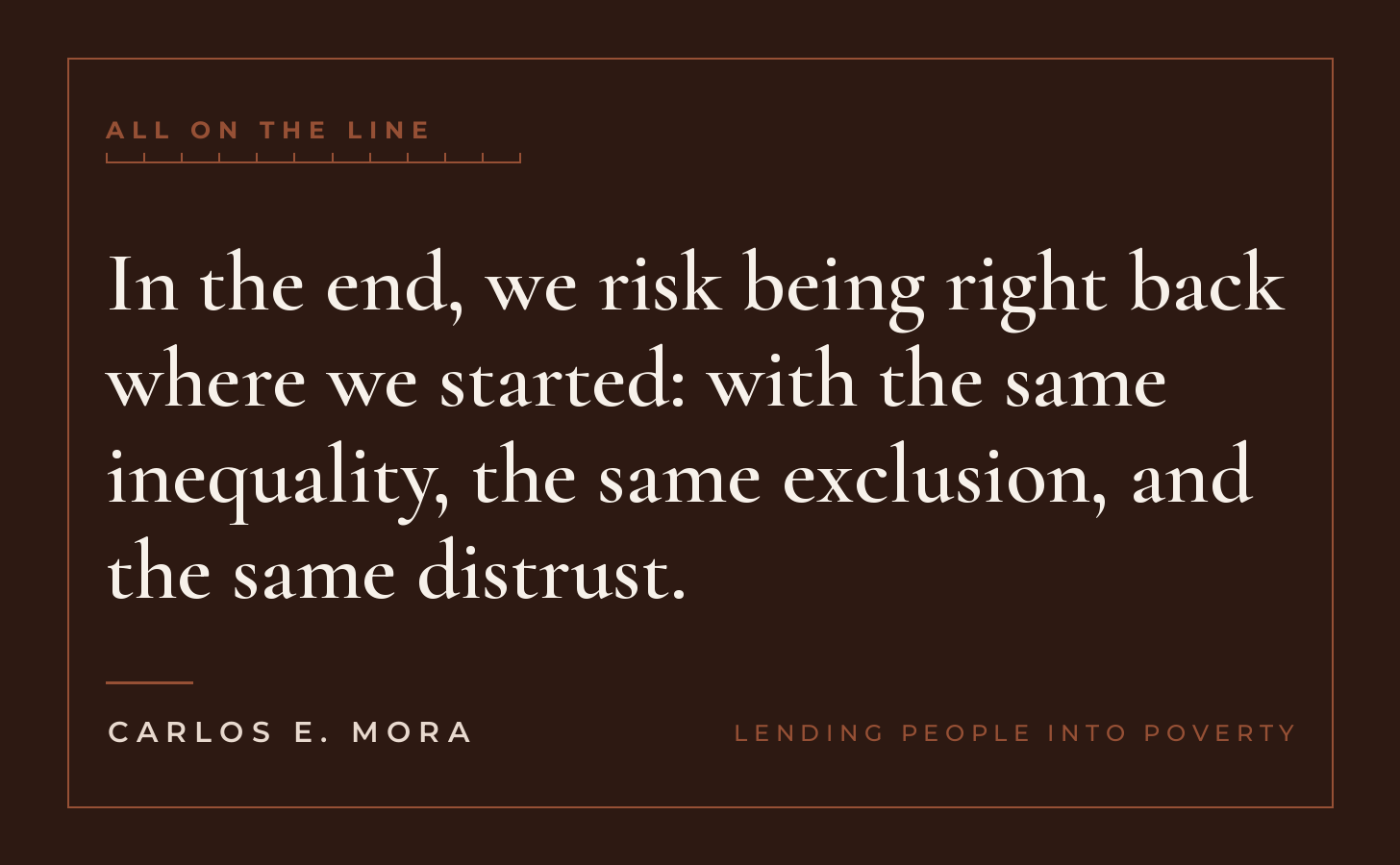
In the end, we risk being right back where we started: with the same inequality, the same exclusion, and the same distrust.
What’s missing from most credit models in Mexico isn’t just better risk scoring or fancier tech, it’s context.
We assume repayment is about discipline. But when people have volatile incomes, no formal contracts, and a family to feed, credit becomes a survival tool, not a financial product. The best-performing models I’ve seen are the ones that adapt to this reality: merchant cash advances based on real POS data, supplier financing tied to formal contracts, salary advances tied to verified payroll streams, and group loans supported by trusted local networks.
These models work not because of tech alone, but because they are grounded in how money actually moves, and how people actually live. But unfortunately, even these lower-risk models often take advantage of Mexico’s overall credit risk profile, charging unforgivingly high interest rates despite being more secure.
Everyone can identify what’s broken, but only a few are willing to sketch a new path forward. What I’m proposing isn’t a silver bullet, but a direction forward. A set of principles that could form the foundation of a credit system that truly works for Mexico.
To build that system, we need to shift the very focus of credit. From consumption to production: too much credit today is used to buy things that depreciate, and instead we should fund tools, inventory, mobility, training, anything that helps people generate income or improve their livelihoods. From acquisition to resilience: rather than measuring success by the number of new borrowers, we should measure it by how many borrowers stay solvent, especially when life gets hard. And from growth at all costs to trust at all levels: speed and scale are important, but trust is the long game, which means building repayment relationships, offering human support when algorithms fall short, and thinking in years, not quarters.
And we need real design shifts. Loans linked to real income streams, whether it’s a merchant’s POS sales or a freelancer’s platform earnings, because tying repayment to actual cash flow makes debt sustainable. Flexible repayment structures that anticipate shocks, where grace periods, dynamic installments, and pause options help borrowers navigate illness, job loss, or family emergencies without defaulting. Embedded micro-insurance or contingency buffers, because a small health emergency shouldn’t push a family into insolvency and lenders could offer optional or bundled protections that reduce both borrower stress and portfolio risk. Human-level underwriting where necessary, since not all risk can be captured through data and especially in rural or informal settings a field visit, a conversation, or a reference can make all the difference. And long-term education campaigns, because financial health starts young and schools, workplaces, and media could all play a role in building the credit culture we currently lack, one based on agency, not fear.
This playbook isn’t the fastest route to scale, but it’s an honest route to change. It won’t create unicorns overnight, but it might create a generation that sees credit not as a trap, but as a tool. And that would be real progress.
Tech won’t fix credit in Mexico on its own, and capital won’t either. The solution won’t come from a single app or product either. But if we rethink what we’re funding, if we design credit that builds, rather than extracts, we can begin to unlock the kind of economic mobility this country deserves.
Because lending isn’t inclusion if it leads to default. And access isn’t progress if it leaves people worse off than before.
We don’t need easier credit. We need smarter credit, grounded in reality, built for volatility, offered with empathy, and scaled with tech. That’s the kind of work I want to be part of, and the kind of future I want to help build.
— Carlos E. Mora
I wake up, I build, I repeat. No guarantees.
I work like it’s all on the line, because it is.
Family is the only true legacy.
Your name is your currency, and it must be earned daily.
The arithmetic in these essays is the arithmetic the practice runs on a mandate.
Discuss a mandate →