All on the Line · Notes from the Builder
For decades we've accepted them as the universal language of business. It's time to ask if they really work, and what should come next.
Communication
28 August 2025
5 minutes
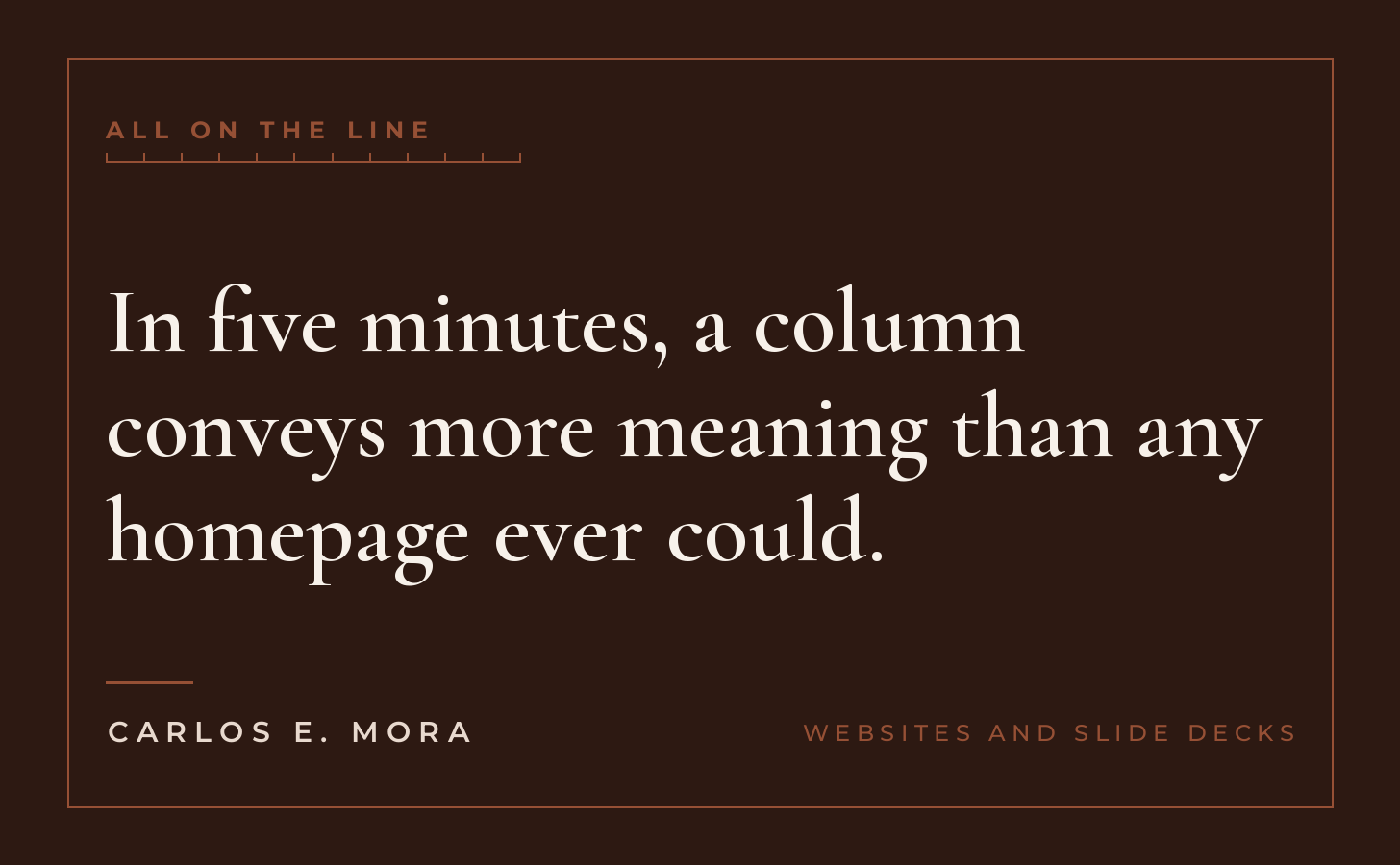
For more than thirty years, two formats have dominated the way we communicate in business: the website and the presentation. They were created in the early days of the internet and Microsoft Office, and we have never really questioned them since. They became unquestioned rituals, the automatic response when someone asks, “Can you tell me about your company?” Yet for all their ubiquity, it is remarkable how poorly they serve us when what we most need to communicate is not just what we do, but why it matters.
It’s worth remembering where these tools came from. PowerPoint was introduced by Microsoft in the late 1980s, and it spread quickly through corporate America in the 1990s. Suddenly, executives had a uniform way to display charts, bullet points, and strategy diagrams. The format wasn’t chosen because it was the best way to communicate ideas, it was chosen because it was easy to standardize, and because projectors needed something clean to display on a wall.
Websites followed a similar path. In the early days of the internet, a company simply needed a digital calling card: a homepage with a logo, a short description, and contact information. As the internet became commercial, websites became the default storefront. But again, this wasn’t because they were the most powerful way to convey meaning, it was because they were the only way to be present online. Over time, “send me your deck” and “check our website” hardened into rituals. Nobody ever voted on these formats. They just calcified into the culture of business.
The problem is that these formats never evolved beyond their origins. A website is supposed to be the front door of an organization. But more often, it is a foggy window. We land on the homepage, greeted by glossy images and generic phrases that could belong to anyone. We scroll through sections and close the tab, still unsure what the company actually does, let alone why it exists or what urgency drives its work.
There is one exception: e-commerce. When the goal is purely transactional, find the product, add to cart, pay, the format works. It’s not perfect, but it’s clear enough to guide the user through the process. Outside of that narrow use case, however, most websites fail to convey either clarity or meaning.
Slide decks fall into the same trap. They give us numbers, graphics, and bullet points, but without context they are snapshots with no story. A chart can show a trend, but it cannot explain what forces created it. A bullet point can announce an action, but it cannot transmit urgency. And when context is missing, people fill in the blanks on their own, sometimes in ways that lead to misunderstanding or even the wrong decisions.
This is why I have come to rely on writing. Before an important meeting, I draft a short memo that frames the conversation. In a few paragraphs, I can unfold the background, lay out the stakes, and transmit the emotion that drives the discussion. Then, when I bring the slides, the numbers finally make sense; they no longer float in a vacuum, but land on ground that has already been prepared. The story holds the logic together, and the visuals highlight rather than replace it.
It goes further than meetings. When I want to explain what I do, I don’t send people to a website anymore. I send them a column. A story gives more than information, it gives context, urgency, and the possibility that lives behind the work. It asks for five minutes of attention, and in those minutes, the meaning gets through in a way no homepage ever could. Case in point: last week I wrote about a venture I’ve been building, The Smile Project. In five minutes, it tells you everything you need to know, and why it matters.
Writing also nudges people in a way a slide never can. A memo or a column is linear, you read it from beginning to end. It carries tone, rhythm, and meaning that guide the reader through the argument. It doesn’t demand more than a few minutes, but those minutes create alignment. And because the form itself feels personal, people actually read it.
Of course, visuals also have their place. A photo can show what something looks like better than any description. A video can transmit energy and emotion in ways text alone cannot. These are powerful tools, but they must orbit around a story. Too often we invert the relationship, leaning on visuals as if they themselves could carry the meaning. They cannot. Their real value comes when they are woven into narrative, when they illuminate a context that has already been set.
The deeper problem is that we have stopped questioning the formats themselves. Websites and slide decks were inventions of the 1990s, and in essence they have not changed since. Meanwhile, everything else in business has evolved, our tools, our markets, our speed of execution. But in the most human task of all, explaining who we are and why we matter, we are still dragging forward relics of another era.
It is time to propose something new. A future of communication where story is the foundation, and visuals are the supporting cast. Where memos, columns, and narratives are the starting point, because they carry context, urgency, and conviction, and then images, videos, and numbers are layered in to reinforce the meaning. Where the formats themselves are designed not to overwhelm, but to nudge people into reading, watching, and understanding.
Because what moves people has never been a homepage or a deck. It has always been a story, told with clarity and conviction, supported by the right evidence and imagery. That is the medium we need to reclaim, and perhaps the medium we need to reinvent.
— Carlos E. Mora
I wake up, I build, I repeat. No guarantees.
I work like it’s all on the line, because it is.
Family is the only true legacy.
Your name is your currency, and it must be earned daily.
The arithmetic in these essays is the arithmetic the practice runs on a mandate.
Discuss a mandate →