All on the Line · Notes from the Builder
From oilfields to fintech platforms to international retail media. This is my journey through those worlds as a startup CFO.
A CFO is the builder of the engine and the designer of the runway. I make sure the vision has the capital, the structure, and the systems to reach full speed, and the endurance to keep going when others stall. My work happens where field execution, product infrastructure, and board-level conviction meet. I’m there when the deal is signed, when the machine is humming, and when the pressure is highest.
From oilfields to fintech platforms to international retail media, I’ve operated in markets where capital is both the oxygen and the constraint, and where one wrong move can cost months of growth. This is my journey through those worlds, the work, the decisions, and the philosophy that guide me as a startup CFO.
The year the oil and gas company I was working for broke through didn’t begin with cash, it began with contracts. After years of chasing small deals, we started winning major tenders with Pemex in Mexico and Ecopetrol in Colombia. They were big enough to change the company’s trajectory, but they came with a condition: the work had to be completed before the first peso arrived.
My mandate was to secure $100 million in credit lines for a company with almost no financing history. That meant knocking on every door, big banks, small banks, energy funds, family offices, in Mexico, Colombia, and the U.S.
One week I’d be in New York pitching with the CEO. The next, I’d be in Coatzacoalcos, Ciudad del Carmen, or Villahermosa, not the cities, but deep in the jungle, walking project sites, reviewing progress against milestones, ensuring suppliers were paid and crews were on track.
Numbers got us into the meeting. Credibility got us the capital. I could tell a lender exactly how much pipe had been laid, when the next inspection was due, how retentions would release, and what it would take to trigger payment from Pemex. We structured the stack with committed revolvers, project-specific ABL, receivables programs tailored to the real payment cycle (never the 90 days on paper, closer to 180 in practice), plus the standby LCs and performance bonds the work demanded. Every covenant and intercreditor term preserved flexibility without surrendering control.
Before the jungle, I’d been in the rooms where numbers reshape entire industries. At Estructura Partners, I worked on some of Mexico’s largest deals, including advising Grupo Casa Saba on its $600 million acquisition of Farmacias Ahumada and Benavides while divesting non-core assets like Citem, Mexico’s largest magazine distributor at the time.
M&A headlines fade; integration lasts. Saba asked me to join as Subdirector de Finanzas (VP of Finance) to make the post-deal company function as one. Treasury flows had to synchronize across Mexico, Chile, and Peru. Vendor terms needed harmonizing without disrupting supply. Inventory finance had to accelerate cash conversion without starving shelves.
It was part chess, part surgery, aligning operations and capital so the combined business was stronger than the sum of its parts. In the boardroom, updates had to cut through noise: one narrative, one set of numbers, one clear next move.
When I founded Upton Financial and later Uptonmart, there were no legacy lines and no brand halo, just a plan, a product, and the will to fund it. Most days began with operations and ended with investor calls. Rejection was constant, but it was data. Every “no” tightened the pitch, sharpened the structure, and forced a better way to extend the runway.
We didn’t wait for the perfect term sheet. We layered revenue-backed instruments, supplier credit, and small equity injections to keep the lights on and growth alive until the right capital arrived. In a startup, the CFO is the buffer that absorbs the hits so the builders can keep building.
Building inside a big bank was a different kind of startup, deep pockets, high expectations. The prevailing view was to burn cash to scale. I wasn’t interested in speed without stability.
I led the launch of Merchant Cash Advance, Buy Now, Pay Later, and interoperable payments as infrastructure embedded into the bank’s core systems. That required underwriting models with defensible vintages and cohorts, risk-based pricing that held under stress, API layers that could handle scale and audits, and data lineage and reconciliation that stood up to regulators.
Half my time was with product and engineering teams, making sure the technology could deliver on what the business promised. The other half was in the boardroom, translating system design into strategic implications: how slow response times turn into lost customers, how a clean ledger avoids damaging restatements, why acquisition without retention is just performance without value. We scaled by building a system designed to run fast for years without breaking.
In retail media tech, timelines are compressed, partners are global, and competition is relentless. We report to a global beverage company’s headquarters, aligning IFRS and partner reporting cadences while preserving startup agility.
My role is to keep vision and viability in lockstep: structuring capital and debt to maximize shareholder value, designing agreements that protect upside without capping it, and managing governance that satisfies enterprise standards without slowing the engine.
Every board meeting is a decision forum, set direction, unify stakeholders, and show exactly how the financial architecture supports the next moves. When finance, product, and operations are locked together, the company moves faster than the market without losing control.
Design capital stacks for control and acceleration, flexible enough to capture opportunities, disciplined enough to withstand shocks. Instrument the system: working capital matched to the real revenue cycle, covenants that measure risk rather than noise, dashboards that surface the few variables that move outcomes. Sequence product with finance, launching in line with ledger capacity, market demand, and operational readiness. Use the board to set trajectory: one narrative, one set of numbers, one clear ask. And protect founder and shareholder upside by structuring every deal so the slope of value accrues to the builders.
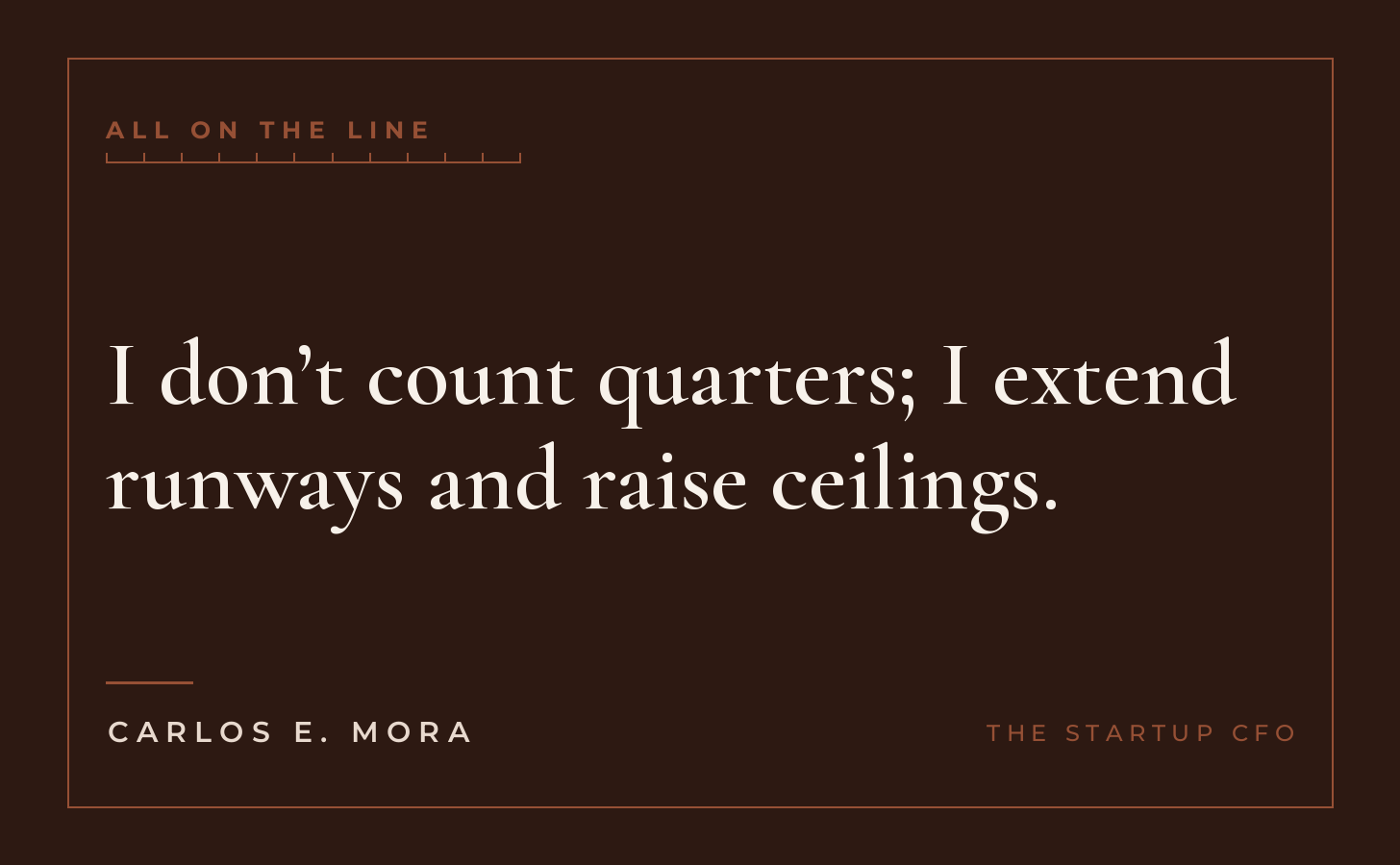
I don’t count quarters; I extend runways and raise ceilings. I sit with engineers to make sure the system won’t lie to finance, and with bankers to make sure finance won’t handcuff the system. I go to the field because capital flows to work that’s real. And when the window opens, I want the company already at speed.
— Carlos E. Mora
I wake up, I build, I repeat. No guarantees.
I work like it’s all on the line, because it is.
Family is the only true legacy.
Your name is your currency, and it must be earned daily.
The arithmetic in these essays is the arithmetic the practice runs on a mandate.
Discuss a mandate →