All on the Line · Payments and Settlement
Tokenized deposits are transforming US–Mexico payments. A clear, accessible primer on the modern rail that will reshape cross-border settlement.
Tokenized settlement
6 December 2025
8 minutes
Cross-border money hides a quiet dysfunction. Goods now move between the United States and Mexico in hours, yet the payments behind those goods often take days to arrive. Trucks clear Laredo faster than invoices clear banks. That mismatch is not a small inconvenience; it is a structural tax on liquidity, competitiveness, and opportunity across an $850-billion corridor. We have built a real-time physical economy on top of a slow-motion financial one, and the friction shows up everywhere: working-capital gaps, uncertainty around settlement, manual reconciliation, and a sense that money is always lagging behind the activity it is meant to support. The world is moving faster, but the rail that carries value across borders is still stuck in the past.
Over the last decade, crypto made a point that is impossible to ignore: people want faster, cheaper, borderless financial movement. Stablecoins move value quickly, and in many emerging markets they’ve already become informal safety nets for savings, transfers, and low-cost remittances. The demand for better rails is real. But mass adoption is a different story. Corporate treasury, institutional flows, regulated cross-border commerce, and consumer payments still operate inside the banking perimeter, governed by frameworks that crypto has not yet bridged. Stablecoins sit outside deposits, exchanges act as intermediaries, and regulatory clarity is still evolving. Crypto reveals the appetite for speed but hasn’t yet delivered a system the mainstream can rely on.
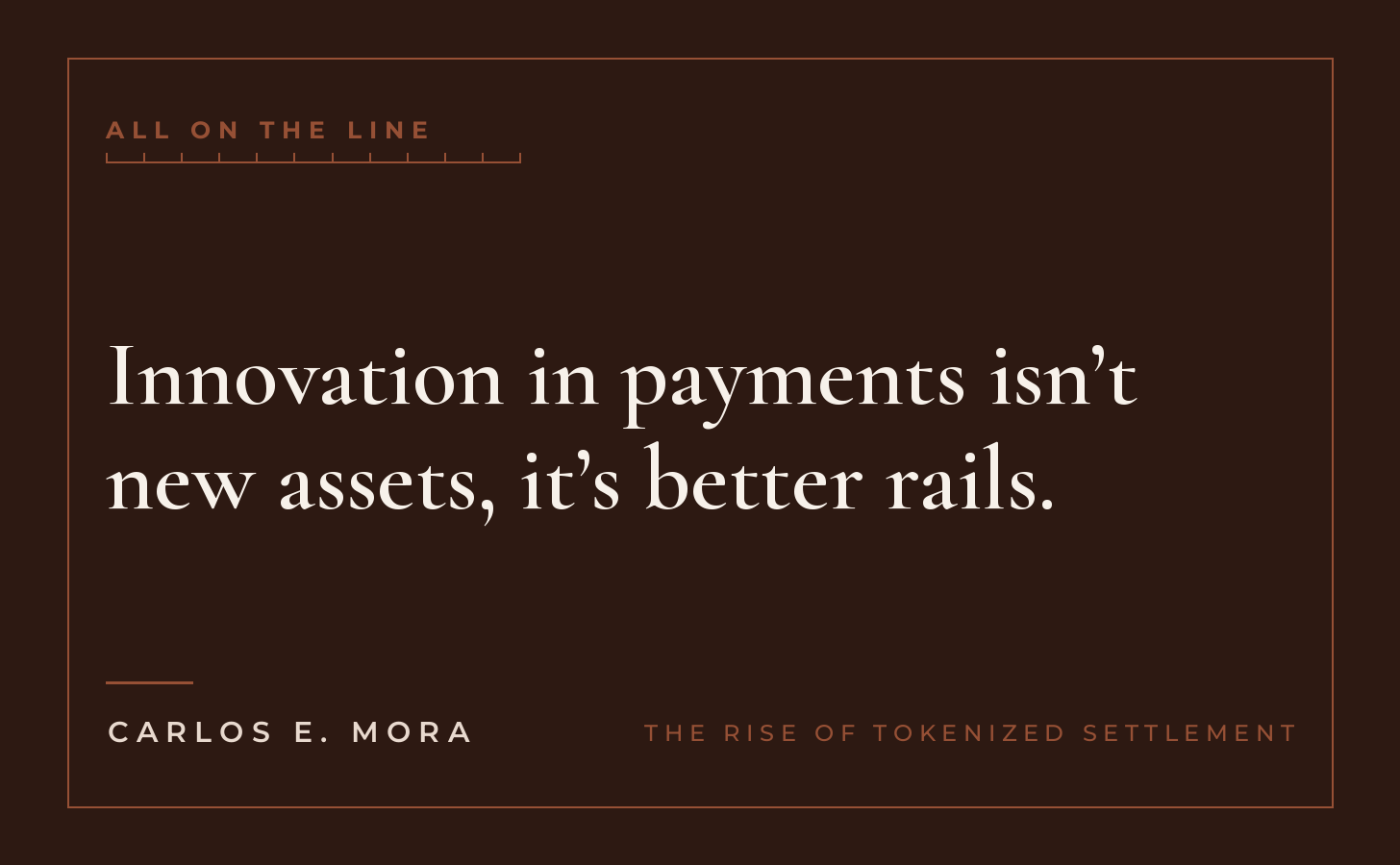
That is why tokenized deposits matter. They do not require new money, they do not require new regulators, and they do not require a leap of faith. A tokenized deposit is simply a traditional bank deposit, insured, supervised, fully redeemable, expressed on a rail built for today’s tempo. The innovation is not the asset; it is the infrastructure that moves it. When a tokenized deposit transfers, settlement happens at that exact moment. The bank updates its ledger in real time. There is no waiting for a correspondent institution to confirm the funds, no multi-step choreography of messages separated from money, no cutoff windows that belong to an earlier age. The transfer is the settlement. The system doesn’t accelerate the old rails, it sidesteps them.
In the legacy model, payments are a two-step process: a message moves first, and the actual value catches up later. That gap is where most of the friction lives. A cross-border payment is sent, but the receiving side sees only a promise until various intermediaries reconcile their books. Each step introduces delay, operational work, and risk. Tokenized deposits erase that gap. When value moves on a tokenized rail, messaging and settlement collapse into one action. The sending bank debits the payer, the receiving institution receives a redeemable claim immediately, and the transaction is final in real time.
This shift changes how risk is distributed through supply chains. If a supplier knows that “payment sent” truly means “funds available,” they no longer have to build timing cushions into pricing or rely on expensive working-capital solutions just to survive the delays of the system. If a logistics operator knows that settlement will trigger automatically on delivery confirmation or customs clearance, it can design operations around predictable liquidity rather than the ambiguity that the old system imposes by default. The moment you stop asking businesses to live with two- or three-day settlement lag, you change how they plan, price, and grow.
The place where this shift matters most is the U.S.–Mexico corridor, because the gap between real economic movement and financial settlement is widest there. Domestic payments have modernized on both sides of the border. The United States has FedNow; Mexico has SPEI, one of the fastest retail-payment systems in the world. But the systems do not speak to each other. Cross-border payments remain stuck in layers of intermediaries: correspondent banks that move on their own timelines, FX agents that intermediate conversion, compliance processes that operate after the fact rather than in real time, and reconciliation work that consumes hours of back-office labor. The rail is too slow for the supply chains it serves.
When a cross-border payment takes two or three days to settle, it creates delays that ripple through every participant in the chain. Manufacturers wait for liquidity before releasing inventory. Logistics companies take credit risk on both sides of the border. Exporters hedge because the system forces uncertainty into their business model. SMEs that already operate close to the edge lose precious days of working capital. These frictions do not appear in macroeconomic models, yet they define the lived reality of an integrated North American economy.
A tokenized-deposit rail simplifies that geometry. The first lane is practical and straightforward: U.S. to Mexico. A U.S. bank issues tokenized USD deposits and transfers them to a Mexican bank that agrees to redeem them instantly. The Mexican bank does not need to tokenize its own deposits at first; it simply pays out the value in MXN or USD the moment the token arrives. This begins as a modernized correspondent relationship where redemption is immediate, final, and fully traceable. Instead of settling in days, value settles in seconds. Instead of passing through multiple institutions, settlement becomes bilateral. Instead of opaque timing, settlement becomes predictable.
The most powerful part of this architecture isn’t the first lane explained before, it’s what becomes possible once the rail exists. A U.S.→Mexico tokenized settlement flow is simply the opening move. The deeper transformation happens when the model evolves into a two-way corridor, because that shift turns an isolated payment innovation into a true financial infrastructure layer for North America.
A bi-directional corridor requires only one additional step: a Mexican partner bank choosing to tokenize its own MXN deposits or adopting a compatible redemption framework. Once that happens, value can move between U.S. and Mexican institutions with the same speed, safety, and programmability in both directions. What begins as a faster payout mechanism becomes a cross-border financial operating system.
In a two-way rail, real-time FX becomes standard rather than optional. Imagine an exporter receiving payment in USD instantly while simultaneously locking in MXN for payroll or supplier obligations at transparent, programmable rates. Imagine a Mexican manufacturer triggering automatic USD-to-MXN conversion at the moment goods cross the border. Imagine treasury departments synchronizing cash positions across subsidiaries in real time, eliminating the liquidity buffers they maintain today simply because the system can’t keep up.
This is not abstract. It is the natural consequence of aligning the movement of value with the movement of goods, people, and information. The U.S.–Mexico economy already behaves like an integrated production ecosystem; what’s missing is an integrated settlement layer. The moment both sides operate on tokenized rails, the corridor stops being two financial systems connected through improvisation and becomes a single financial region with continuous liquidity. This is the strategic heart of the opportunity: a one-way rail reduces friction; a two-way rail reshapes the corridor.
This difference becomes even clearer in the remittance corridor, where architecture limits progress more than ambition does. For years, remittance startups have built smoother, cheaper, more intuitive products. They’ve designed clever onboarding, negotiated better FX, improved transparency, and in some cases moved funds through stablecoins to escape the slow choreography of correspondent banks. These innovations matter. They reflect genuine care for migrant families and a deep understanding of user behavior. But even the most advanced remittance products remain tied to the same settlement infrastructure. They still rely on payout agents that wait for funds to arrive. They still depend on liquidity providers that expect transfers to clear on legacy timelines. They still reconcile across systems that cannot speak to each other in real time. They have improved the experience but not the substrate.
Crypto brings a different kind of speed, especially through stablecoin rails. But even here, the last mile depends on traditional payout networks. A stablecoin can cross a blockchain in seconds, but converting it safely, predictably, and compliantly into money that a family can use in Mexico still requires the old rail to complete the journey. Crypto solves part of the problem and introduces new ones, trust in issuers, custody risk, regulatory uncertainty, and conversion steps that recreate friction before the beneficiary can access funds.
Tokenized deposits avoid both sets of constraints. They offer the speed that crypto revealed without asking senders and recipients to adopt new assets, and they offer the safety of commercial bank deposits without forcing those deposits to crawl through outdated rails. A tokenized USD deposit sent from the United States can be redeemed instantly by any Mexican institution integrated into the system. The recipient sees real money, not a placeholder. There is no volatility, no custodian risk, no exchange-rate surprise. The startup that owns the user relationship gains a rail that finally aligns with the expectations it sets. The bank gains transparency and better compliance. The family gains time and value. Everyone gains a system that moves at the speed of modern life.
This new rail does not conflict with crypto; it creates the bridge that makes future integration possible. A tokenized-deposit system can support onramps, offramps, stablecoin liquidity, and digital-asset flows without compromising regulatory clarity or settlement finality. It can serve institutional and retail flows under the same architecture. It offers speed without volatility, programmability without speculation, and modernization without asking users to abandon the system they already trust.
If tokenized settlement is so powerful, why hasn’t every institution deployed it? Because the challenge is no longer technology, it is coordination. Standards must align. Regulators must gain comfort. Cross-border partners must agree on redemption mechanics and compliance visibility. Banking systems with decades of embedded processes must adapt. Large institutions move slowly by design, especially when change touches their core. But that inertia creates a rare opening. A bank with the right mix of technology, regulatory discipline, and cross-border heritage can build these rails ahead of the industry curve. And once liquidity begins to flow through a rail, once supply chains, platforms, and families depend on it, that rail becomes the default path.
This is not a marginal upgrade. It is the modernization of the financial infrastructure that binds two nations and millions of households together. It increases the tempo of commerce, reduces the cost of remittances, clarifies compliance, and collapses the unnecessary distance between economic activity and financial settlement. It turns cross-border money movement from a liability into an accelerant. And it brings the financial system closer to the world it already serves, fast, integrated, and unconcerned with borders that value can no longer afford to respect.
The future will look obvious once it arrives, it always does. But today, the opportunity is still visible in the gap between the world we see and the rails we don’t. Whoever closes that gap first will define the financial architecture of the U.S.–Mexico corridor for decades to come.
— Carlos E. Mora
I wake up, I build, I repeat. No guarantees.
I work like it’s all on the line, because it is.
Family is the only true legacy.
Your name is your currency, and it must be earned daily.
The arithmetic in these essays is the arithmetic the practice runs on a mandate.
Discuss a mandate →