All on the Line · Mathematics and Markets
The limits of verification: proving a curve optimal took mathematics 135 years; one Saturday the market priced USDC’s gap at $1.7 billion.
The limits of verification
6 September 2026
13 minutes
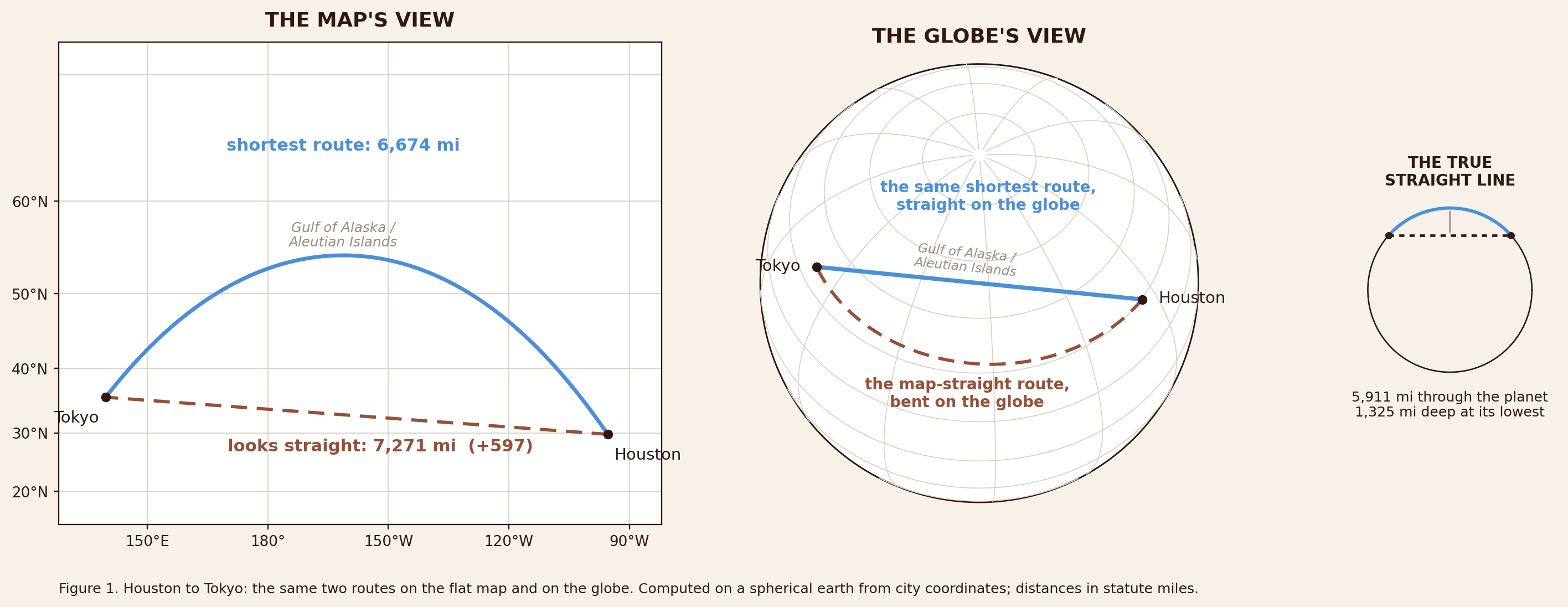
What is the shortest route between two cities on the surface of the earth? Between Houston and Tokyo a truly straight line does exist, but you would have to dig it: it runs through the body of the planet, some thirteen hundred miles beneath the Pacific at its deepest, down in the mantle.1 And nothing is shorter: about fifty-nine hundred miles, more than seven hundred fifty fewer than any route along the surface. Stay on the surface and every route you can actually travel is a curve, so the question becomes which curve is shortest. The answer is an arc of a great circle, one of the giant circles that cut the globe in half, the equator being the most famous one. Trace the shortest route across the surface from Houston to Tokyo and it arcs far north, across the Gulf of Alaska and out along the Aleutian Islands, climbing more than eighteen degrees of latitude above either city. Real flights track close to that arc, bending with the winds and the day’s weather. On the globe that arc is as straight as the surface permits; the flat map is what bends it. And the route that looks straight on the flat map, running out across the middle of the Pacific, is the genuinely bent one, and nearly six hundred miles longer.
In 1744 Leonhard Euler, whose collected works run to more than eighty volumes, published the general method for finding the optimal curve, whatever optimal means for the problem at hand: the shortest route, the fastest ramp, the flight path that burns the least fuel.2 At its center is one equation that the optimal curve has to satisfy. But there was a caveat. The method implied that the optimal curve had to satisfy the equation, and not that any curve satisfying the equation was optimal. In mathematical terms, this means that the equation was a necessary condition for the optimal curve, but it was not a sufficient condition. And in practice, it means that Euler’s equation was not a final solution, and for four decades nobody was able to come up with one.
The problem was still open in 1786, when Adrien-Marie Legendre, one of the leading mathematicians in Paris, presented a memoir to the Academy of Sciences claiming to have solved it.3 Legendre had found a second, sharper test, and he believed the two conditions together were sufficient: a curve that passed both was, he argued, guaranteed to be optimal. But the proof had a hole. Legendre assumed that one step of it, a construction that had to hold along the entire length of the curve, would always work, and he never proved that it would. Joseph-Louis Lagrange, then the greatest living authority on the mathematics of motion and a man whose masterwork Legendre had edited, set out objections in 1797, and for a generation the idea was shelved as a promising instrument that had failed.
Finding the hole took fifty-one years. In 1837 Carl Jacobi, a German mathematician then at the height of his powers, located it.4 Start again in Houston. The place on the planet farthest from Houston is the single point directly opposite it, on the other side of the earth, out in the southern Indian Ocean. Fly out of Houston along any great circle and, all the way to that farthest point, flying straight and flying the shortest way are the same thing. One mile past it, they separate. The route is still perfectly straight, but every destination beyond the farthest point sits closer to Houston in the opposite direction, so each additional straight mile now takes you the long way around. Straight has stopped implying shortest, and it stopped at one exact, computable point. This was Legendre’s hole. The step he assumed would always work does work on every arc that ends before the point opposite its start, and fails on every arc that continues past it. His proof was true for arcs shorter than half the circle and false for arcs longer than that, and none of his tests could tell the difference. Mathematicians later named these breakdown places conjugate points, and Jacobi’s check joined the stack as one more necessary condition: a curve carried past its conjugate point cannot be optimal, and a curve short of it still might be.
Even with the hole located, closing it took another generation. A full guarantee, one that certifies a curve against every rival rather than only its nearest neighbors, arrived with Karl Weierstrass, the Berlin professor who spent his career rebuilding calculus on rigorous foundations, in his lectures of 1879.5 Legendre had compared the route only against slightly deformed versions of itself, so what his tests truly certified was that the route was the best of the versions he compared it against. Weierstrass compared it against everything the problem allows. He covered the entire region with a family of candidate routes, one passing through every point and none of them crossing, and showed that any rival route, wherever it wanders, can be measured against that family stretch by stretch, with every stretch of deviation costing extra. A route that pays extra everywhere it deviates cannot arrive cheaper. In plain words: best is a relative verdict, the winner of whatever comparison you actually ran, while optimal is absolute, better than every rival there is. Legendre certified a best and believed he had certified the optimum. Weierstrass’s covering comparison is what certifying the optimum costs, and a certificate that reaches every rival is what sufficient means. Euler wrote the equation in 1744; Legendre claimed sufficiency in 1786 and was wrong; Jacobi found the flaw in 1837; Weierstrass delivered the guarantee in 1879. From the necessary condition to the sufficient one, on a problem where nothing was hidden and nothing changed, the crossing took one hundred thirty-five years.
In March 2023 the second-largest stablecoin in the world was a token called USDC, issued by a company called Circle. A stablecoin is a digital token built to be worth exactly one dollar at every moment, and USDC’s version of the promise had two working parts. The first was redemption: hand Circle a token and receive a dollar, a transfer that settles through ordinary banks. The second was the open market, where tokens change hands around the clock at whatever price buyers will pay. As long as redemption works, the two prices are welded together, because nobody sells for ninety cents what the issuer redeems for a dollar. Behind the redemption promise sat roughly US$40 billion of reserves, most of it in short-term Treasury bills, the remainder held as cash at banks.6
How did anyone know the reserves were real? Through an attestation: once a month, an accounting firm examined Circle’s holdings and signed a report confirming that at given instants the assets existed and covered the tokens outstanding.7 It is a test with the same shape as Euler’s equation, a condition that any healthy stablecoin must satisfy. In mathematical terms, it is necessary, but nothing about it is sufficient. The market had built a taller structure on that monthly signature anyway: verified at an instant was read as fully backed, fully backed was read as redeemable at a dollar, and redeemable at a dollar was read as always, which is the exact word Circle’s own page used to end the promise. An attestation speaks as of a chosen midnight. The promise covers every instant there is.
On Friday, March 10, 2023, regulators closed Silicon Valley Bank, the sixteenth-largest bank in the country, after depositors had pulled roughly US$42 billion the day before.8 Just after ten that night Circle disclosed that US$3.3 billion of its reserve cash was inside, about eight percent of everything standing behind the token. And the closure jammed the promise’s first working part directly: a redemption settles through banks, the banks were shut until Monday morning, and so the machine that turns a token back into a dollar had stopped.
With redemption dark, the weld broke. The market price stopped being an echo of a working exchange window and became the market’s live vote, updated by the minute, on whether the promise would still be standing when the banks reopened. By early Saturday the vote read eighty-eight cents.9 Walk through what had failed by that point, because the list is short. The attestations were honest. The reserves were real, and the report describing them was accurate. Even a total loss at Silicon Valley Bank, which nobody expected, would have cost the token eight cents; the market had marked it down twelve. The guarantee had expired at one specific place, exactly as it did on the globe past the point opposite Houston, and it was a place no attestation had ever been pointed at: the rails a dollar travels on.
The failure has a precise mathematical shape. Live for a moment inside the world of fractions, the whole numbers and their ratios, and try to reach the number whose square is exactly two. You can get close, and then closer: 1.4, fourteen tenths, squares to 1.96; 1.41 squares to 1.9881; 1.414 squares to 1.999396, each step an ordinary fraction, the sequence crowding in on its target from below. It can crowd forever, because the target is missing from that world: no fraction multiplied by itself gives exactly two, a fact proved about twenty-five centuries ago. Mathematicians call a world with no missing destinations complete. Their word for such a world is a space, and completeness belongs to the space; the sequence, however disciplined, cannot supply it. The space that matters here is the set of outcomes a token can actually reach through the system, everything a holder can turn a token into, and it needs naming precisely because it is not the set of dollars. The dollars existed all weekend, sitting in accounts across the banking system, which is the honest disanalogy with the missing number: nothing had vanished. What the weekend removed was the dollars’ membership in the reachable world, and a dollar that cannot be reached is, for every purpose inside that world, a point that is not there. Over that weekend the stablecoin system was that world of fractions. Every check inside it could still pass, every verification could land closer to the dollar, and the destination, a dollar actually delivered, was missing from the space the system settled in.
Mathematics made this exact mistake once, inside its own house, and the man who caught it was Weierstrass again. Bernhard Riemann, one of the greatest mathematicians who ever lived, rested a famous argument on the assumption that an optimal function existed, because the quantity he was minimizing could be pushed arbitrarily close to its lower bound.10 Weierstrass objected that pressing close proves nothing about arrival, since the target can be missing from the space being searched, and the repair, in its mature form, consisted of changing the space the search ran in, completing it, and proving that the minimum was actually attained there. The two cases share their structure exactly. In both, every check available on the inside can pass while the destination sits outside the world being searched, and no discipline in the searcher can put it there. In both, the repair belongs to whoever can change the world rather than the search: mathematics rebuilt its space and proved the arrival, and the world the token settles in could be rebuilt, that Saturday, only by the institutions that own its rails. Which is the limit both cases demonstrate, and it is a limit on verification itself: a check examines the traveler, and whether the world contains the destination was never the traveler’s fact to establish.
The point was added back on Sunday evening. At 6:15 p.m. Washington time, the Treasury, the Federal Reserve, and the FDIC issued a joint statement: every depositor of Silicon Valley Bank would have access to all of their money on Monday morning, the losses covered under an emergency authority the law reserves for systemic risk.11 As banking policy, it was a depositor rescue. As geometry, it was an edit to the space: from that sentence forward, every route that ended at the failed bank ended at dollars again. Nobody recapitalized Circle. Nobody bought the token. The signers changed the world the token settles in, and the destination missing since Friday night existed again. By Monday the banks were open, redemptions were flowing, and the token traded back at a dollar.
The weekend’s pricing left behind one number worth an autopsy. Take Saturday’s worst case seriously: suppose the US$3.3 billion at the failed bank had been a total loss, every dollar gone. Even then, the assets behind each token would have been worth about ninety-two cents.12 Credit risk, pushed to its theoretical maximum, could justify a price of ninety-two. The market printed eighty-eight. Those four cents below the worst case are the part the reserve balance sheet alone cannot explain. What they priced sits on no balance sheet at all: the possibility that perfectly good assets cannot become dollars in hand when the rails are gone. For one weekend, the market quoted incompleteness itself, and it quoted it at four cents on the dollar. Across the tokens outstanding, those four cents came to about US$1.7 billion, the market value assigned, for a few hours that Saturday, to a point that was not there.
There had been a private attempt at completion. Circle promised that weekend to stand behind the token and cover any shortfall from its own resources.13 The promise was sincere, and it was smaller than the hole: Circle’s later filings put shareholders’ equity at about US$339 million at the end of that year, a tenth of the amount that had been frozen, and equity is the most generous measure available of what the company could have mobilized in a weekend. A promise to complete a space is worth the balance sheet of whoever makes it. Completeness for the dollar’s space was only ever available from the institutions that define the space, which is why the sentence that repaired it carries three government signatures and no price.
Set the two closures side by side. In mathematics the completing hypothesis is named before anyone relies on the result: Jacobi published the condition to check, Weierstrass proved the guarantee, and only then did the discipline treat a best as an optimum. In the dollar’s space the order ran backwards. The reliance came first, years of it, priced at a dollar and stamped Always; the hypothesis arrived at 6:15 on a Sunday evening, forty-four hours after the counterexample started printing. And the two closures do not age alike. Weierstrass’s cannot be taken back, because a proof that reaches every rival is permanent. Sunday’s lasts exactly as long as the signers’ next decision, renewed, or not, one crisis at a time. Mathematics spent one hundred thirty-five years on its gap and closed it once, forever. The dollar’s gap was closed in forty-four hours, by a promise carrying the force of law, and that kind of sufficiency has to be believed before it can be tested.
— Carlos E. Mora
I wake up, I build, I repeat. No guarantees.
I work like it’s all on the line, because it is.
Family is the only true legacy.
Your name is your currency, and it must be earned daily.
1.Computed on a spherical earth of radius 6,371 km, city coordinates for Houston (29.76°N, 95.37°W) and Tokyo (35.68°N, 139.65°E). The straight-line chord, the Euclidean straight line through the earth’s interior, runs 9,513 km (5,911 mi) end to end, 1,227 km (763 mi) shorter than the surface great circle, and bottoms out 2,132 km (1,325 mi) below the surface, in the lower mantle. The surface great-circle distance is 10,740 km (6,674 mi); the map-straight route, a path of constant compass bearing, runs 11,701 km (7,271 mi), longer by 961 km (597 mi), about 8.9 percent. The great-circle route peaks at 54.4°N near 161.3°W. Actual flight tracks deviate from the great circle for jet-stream winds, diversion-airport rules, and airspace; the geometry is the first-order shape of the route.
2.Leonhard Euler, Methodus inveniendi lineas curvas maximi minimive proprietate gaudentes (1744). His collected works, the Opera Omnia, run to more than eighty volumes. The branch is the calculus of variations; the equation is the Euler-Lagrange equation, the field’s first-order necessary condition.
3.Adrien-Marie Legendre, “Mémoire sur la manière de distinguer les maxima des minima dans le calcul des variations,” Mémoires de l’Académie royale des sciences, année 1786, pp. 7-37, with supplementary remarks in the volume for 1787, pp. 348-351; read in 1786, printed in 1788. Legendre’s second test was the second variation, the functional analogue of the second derivative test; the assumed step was the global solvability of an auxiliary equation of Riccati type. See H. H. Goldstine, A History of the Calculus of Variations from the 17th through the 19th Century (Springer, 1980), ch. 4, “Lagrange and Legendre,” pp. 110-150. The masterwork Legendre edited is Lagrange’s Méchanique analytique; Lagrange’s objections appear in his Théorie des fonctions analytiques (1797).
4.Carl Gustav Jacob Jacobi, “Zur Theorie der Variations-Rechnung und der Differential-Gleichungen,” Journal für die reine und angewandte Mathematik, Bd. 17 (1837); some histories date the paper’s composition to 1836, and the fifty-one-year span in the text runs from the 1786 memoir to the 1837 publication. On a sphere the conjugate point of a departure point is the point diametrically opposite it, where all great circles from the departure tie; in other problems the breakdown point sits elsewhere, and its location is part of what Jacobi’s condition computes; Goldstine treats Jacobi in ch. 5, pp. 151-189. Jacobi’s condition together with Legendre’s strengthened test certifies a minimum against nearby rivals; the certificate against all rivals is Weierstrass’s.
5.Karl Weierstrass, Vorlesungen über Variationsrechnung, Berlin lecture courses of the 1870s, canonically the 1879 course, published in his collected works; Goldstine’s treatment is ch. 6, pp. 190-249. The covering family of candidate routes is the field of extremals; the stretch-by-stretch toll is the excess function E. The sufficiency theorem is conditional: it requires a field covering the region and a nonnegative excess on it, and within those hypotheses the comparison reaches every admissible rival, including rivals far from the candidate. Mathematicians also speak of local optima; in the body’s vocabulary a local optimum is a best, the winner against nearby rivals only, and optimal is reserved for the global sense.
6.Reserve size and composition per Circle’s March 11, 2023 statement: roughly US$40 billion in total, with $32.4 billion in short-dated Treasuries and $9.7 billion in cash at banks.
7.Monthly reserve attestations: examinations under AICPA attestation standards expressing an opinion on management’s assertion as of report dates at 11:59 p.m. UTC; produced by Grant Thornton through the period, with Deloitte announced as successor in January 2023. The promise language, “backed 100% by highly liquid cash and cash-equivalent assets” and “always redeemable 1:1 for US dollars. Always.”, is Circle’s transparency page as it read through the period; the page as accessed September 6, 2026 retains the backed-100% and always-redeemable-1:1 language.
8.Withdrawals of roughly $42 billion occurred on Thursday, March 9, 2023, per the FDIC; the California regulator closed Silicon Valley Bank the following morning and appointed the FDIC receiver. Circle’s disclosure came at 10:11 p.m. ET that Friday night; its March 11 statement put $3.3 billion at the bank, about 8 percent of the reserve.
9.CoinGecko recorded a low of $0.88 early Saturday, March 11, 2023; some venues printed lower. Redemptions settle through banking rails, which were closed until Monday.
10.The crowding sequences are Cauchy sequences; a space containing every such limit is complete; the rationals fail at √2. Riemann’s argument is the Dirichlet principle; Weierstrass read his counterexample to the Berlin Academy on July 14, 1870; it was printed in his collected works in 1894. Hilbert’s rehabilitation (1900-1904) proceeded through existence theory, and the modern formulation conducts the search in completed function spaces, where attainment of the minimum is proved. The financial case is a structural parallel, not a metric-space completion: the shared structure is verified approach toward a target absent from the ambient set, remediable only by enlarging the set from outside.
11.Joint statement by the Treasury, Federal Reserve, and FDIC, March 12, 2023, released 6:15 p.m. EDT (federalreserve.gov), invoking the systemic risk exception, 12 U.S.C. §1823(c)(4)(G); all Silicon Valley Bank depositors given access to their money on Monday, March 13. Circle’s 10:11 p.m. Friday disclosure to the statement spans about 44 hours; to bank opening Monday, about 59. USDC returned to par on Monday.
12.Zero-recovery arithmetic: on the ~$40 billion reserve of Circle’s statement, (40.0 − 3.3)/40.0 = 91.75 cents per token; on the March 11 breakdown total of $42.1 billion, 92.16 cents. Against the $0.88 low, the market printed 3.75 to 4.16 cents below the total-loss floor; scaled across the roughly $42.1 billion of tokens backed, that component corresponds to $1.6 to $1.75 billion of market value at the trough, a mark-to-market quantity at the low print, not a realized loss. Total loss was never the expectation; uninsured depositors of failed banks historically recover a substantial share.
13.Circle’s commitment to cover any shortfall from corporate resources: Circle communications, March 11, 2023 (paraphrased). Stockholders’ equity of US$339.5 million as of December 31, 2023, per Circle’s Form S-1 (filed April 1, 2025), roughly one tenth of the $3.3 billion then frozen; the equity figure is the year-end value, cited as scale rather than as March liquidity.
The arithmetic in these essays is the arithmetic the practice runs on a mandate.
Discuss a mandate →