All on the Line · The Mathematics of Dealmaking
Double the losses, half the profits. A blunt rule that reframes risk without killing deals.
Stress testing
18 September 2025
6 minutes
In corporate finance there is a chart that appears so often it has become part of the landscape. The historical numbers jog sideways for a time, sometimes even downward, and then the forecast arcs sharply upward. The line bends like a hockey stick. It shows up in pitch books, investor decks, and IPO roadshows. It is the universal symbol of optimism, the visual promise that tomorrow will be better than yesterday. Entire financial decisions, worth billions, are made with this curve as the backdrop.
Even the so-called “conservative case” rarely feels conservative. Losses may appear for a year or two, but they rarely last more than three. By year four the line bends up again, as if gravity can only apply for a short while. The “downside” is never really down, it is only a less ambitious version of the upside. The effect is subtle but powerful. It creates the illusion of safety: that in the worst case you will not lose, you will only win less. That illusion, repeated in spreadsheet after spreadsheet, hides fragility. It shields decision-makers from the real question: what happens if the future is not better?
Optimism is not a flaw, finance depends on it. The problem is when optimism is the only lens we use. To counter this, I suggest a blunt but memorable rule of thumb:
Double the losses, half the profits, by hitting sales (the Hockey Stick Test).
If the model shows a $20 million loss in Year 1, make it $40 million. If it shows $100 million in EBITDA in Year 5, assume $50 million. Do this across the forecast by adjusting sales, the line most prone to optimism and the one most fragile to reality.
This is not meant to replace detailed stress testing. Private equity firms, lenders, and sophisticated investors go far deeper. They cut exit multiples, push synergies out, adjust working capital assumptions, and measure covenant headroom with precision. That work is indispensable.
But before spending weeks in a twenty-tab model, a first filter can be as simple as bending the hockey stick. If the deal collapses under this quick stress test, it was never strong enough to begin with. And if it holds, then it deserves deeper diligence.
The beauty of this rule is that it reframes risk without killing deals. It does not say “walk away.” It says: “Here is what pain could look like, are you prepared for it?”
This turns risk management into something more than pessimism. It becomes a discipline of clarity. By doubling the losses and halving the profits, you are not forecasting the future, you are testing the story. You are asking whether the thesis is resilient, whether the company has enough liquidity, and whether you as an investor have the patience to live through disappointment.
The value of this approach comes alive when applied to a real company. Take Uber’s IPO in 2019. The roadshow narrative was classic hockey stick. Losses would narrow quickly, profitability was “right around the corner,” and investors could expect rapid upward momentum. At IPO pricing, many thought they were buying into a sprint, a company about to turn the corner.
Now apply the Hockey Stick Test. Double the early losses, halve the later profits. Suddenly breakeven is years away, free cash flow looks weaker, and the road ahead is less a sprint and more a marathon. And what actually happened? The reality sat somewhere in between. Uber’s losses deepened far more than promised, the stock lost half its value after the IPO, and profitability did not arrive until 2023–24. But investors who stayed the course have doubled their money: Uber today trades more than 120% above its IPO price.
Was that a good investment? In absolute terms, yes: 16% annualized returns over five years are solid. But compared to the Nasdaq’s performance in the same period, Uber was closer to average. More importantly, those returns only came to investors who had the liquidity and conviction to survive the years of pain.
The cleanest way to see the gap between the hockey stick and the reality is to put the numbers side by side.
At the IPO, Uber’s memo told a familiar story: a couple of years of losses, then a sharp climb to steady profitability. Apply the Hockey Stick Test, double the losses, halve the profits, and the curve looks very different. Suddenly the breakeven point slips, the climb is flatter, and the rosy future feels far less inevitable.
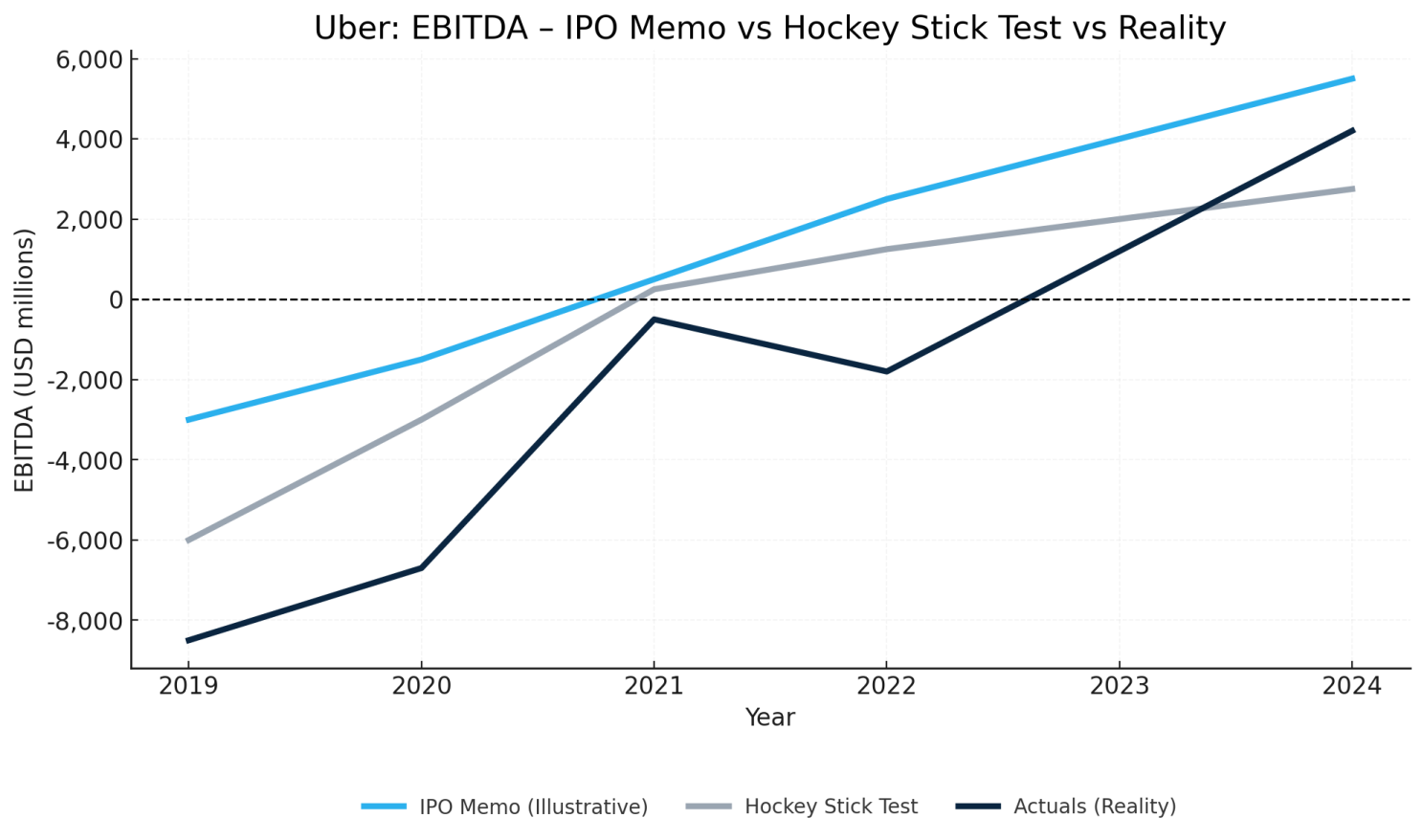
That’s the first chart. It shows the original IPO memo, the Hockey Stick Test adjustment, and what actually happened. The takeaway is hard to miss: reality bent much closer to the Hockey Stick Test than to the IPO story. Investors didn’t get the smooth climb they were promised. They got years of red ink and only a slow turn upward.
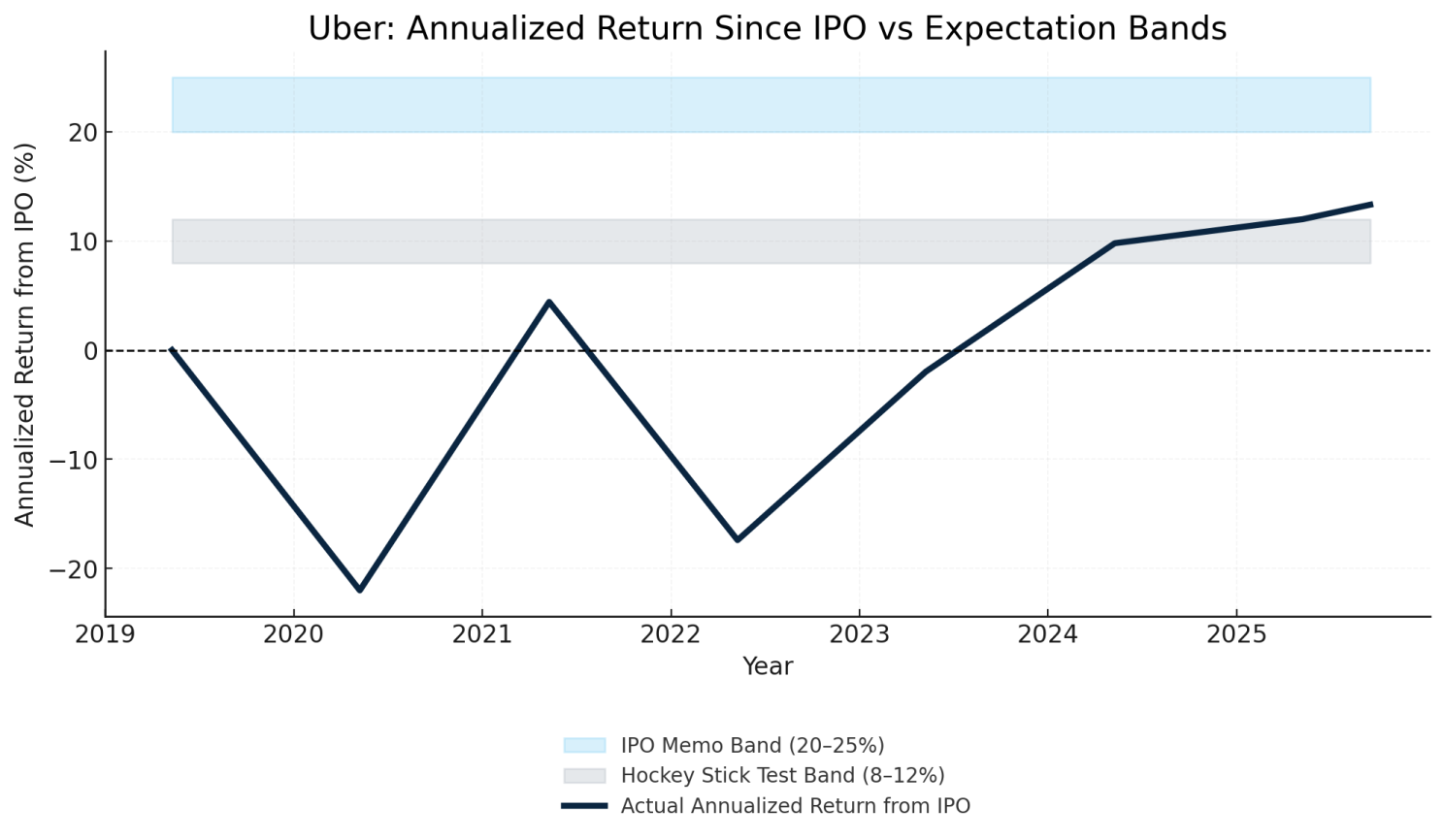
The second chart translates that operating reality into the investor experience. It tracks the annualized return since IPO, not just the stock price. This is what it felt like to own Uber. For the first four years, the line sat below zero. At one point, holding Uber meant a –20% annualized return. Only in the last stretch has it finally crawled into the Hockey-Stick-Test range, brushing past it slightly but still sitting below the IPO memo’s promise.
The end result today looks good. But to get here, investors had to stomach years of losses, drawdowns, and uncertainty. The story the IPO memo told was a sprint. The Hockey Stick Test revealed it was really a marathon. And the numbers show which one turned out to be true.
The lesson extends beyond one company. WeWork’s failed IPO, roll-ups in retail and healthcare that collapsed under debt, or solar projects that depended on eternal subsidies all followed the same script: a hockey stick forecast, a brief dip into losses, and a sharp bend into profitability.
Had the losses been doubled and the profits halved at the outset, many of those deals would have failed the test immediately. They would have revealed themselves not as investments, but as stories too fragile to survive contact with reality. A model that only shows pain for a year or two is not a model, it is marketing. Risk management is not about blocking every deal, it is about knowing how much pain the story can take before it breaks.
The Hockey Stick Test does not predict winners or losers. It does not tell you whether to invest. It tells you what kind of investor you need to be. If the story collapses when losses are doubled and profits are halved, then it is not sturdy enough. If it still holds, then you can enter with eyes open, prepared for the marathon rather than the sprint.
In finance, optimism will always be for sale. What investors and operators must bring is discipline.
— Carlos E. Mora
I wake up, I build, I repeat. No guarantees.
I work like it’s all on the line, because it is.
Family is the only true legacy.
Your name is your currency, and it must be earned daily.
The arithmetic in these essays is the arithmetic the practice runs on a mandate.
Discuss a mandate →