All on the Line · Notes from the Builder
I studied applied mathematics from 2001 to 2005 at ITAM. AI wasn’t a buzzword then, and I now realize that was the beginning.
Mathematics as a mindset
28 May 2025
4 minutes
I studied applied mathematics from 2001 to 2005 at ITAM. At the time, AI wasn’t a buzzword, neither was fintech. Our focus was algebra, calculus, operations research, number theory, and statistics. I worked on optimization problems in MATLAB, not knowing how relevant they’d be years later. I wasn’t thinking about artificial intelligence, I was thinking about models, constraints, and solutions. Today, I realize that was the beginning.
Back then, people assumed that applied math meant one of two things: becoming a professor or working in finance. I chose finance. I had no idea that years later I would be building fintech platforms, advising technology companies, and launching ventures that connect people, banks, and data in real-time. I wasn’t coding every line, but I understood the architecture because math gave me that ability.
It didn’t hit me all at once. But over the years, through building fintech platforms, solving credit underwriting models, and refining algorithms to better serve real users, I started to notice something: the problems I was solving looked a lot like the problems I studied in school. Whether I was assessing credit risk for unbanked populations, designing installment-based payment platforms, or mapping cash advance models using merchant transaction data, the logic mirrored what I learned in operations research. I was doing constraint optimization, probability, and linear algebra, only this time, the variables were real people, real behavior, and real money.
And then I heard Bill Gates say something that stuck with me: he became a great programmer because he was first a mathematician. It gave him the right framework. That made sense because programming is about precision, yes, but building systems is about structure, relationships, and logic. That’s what math trains you to see.
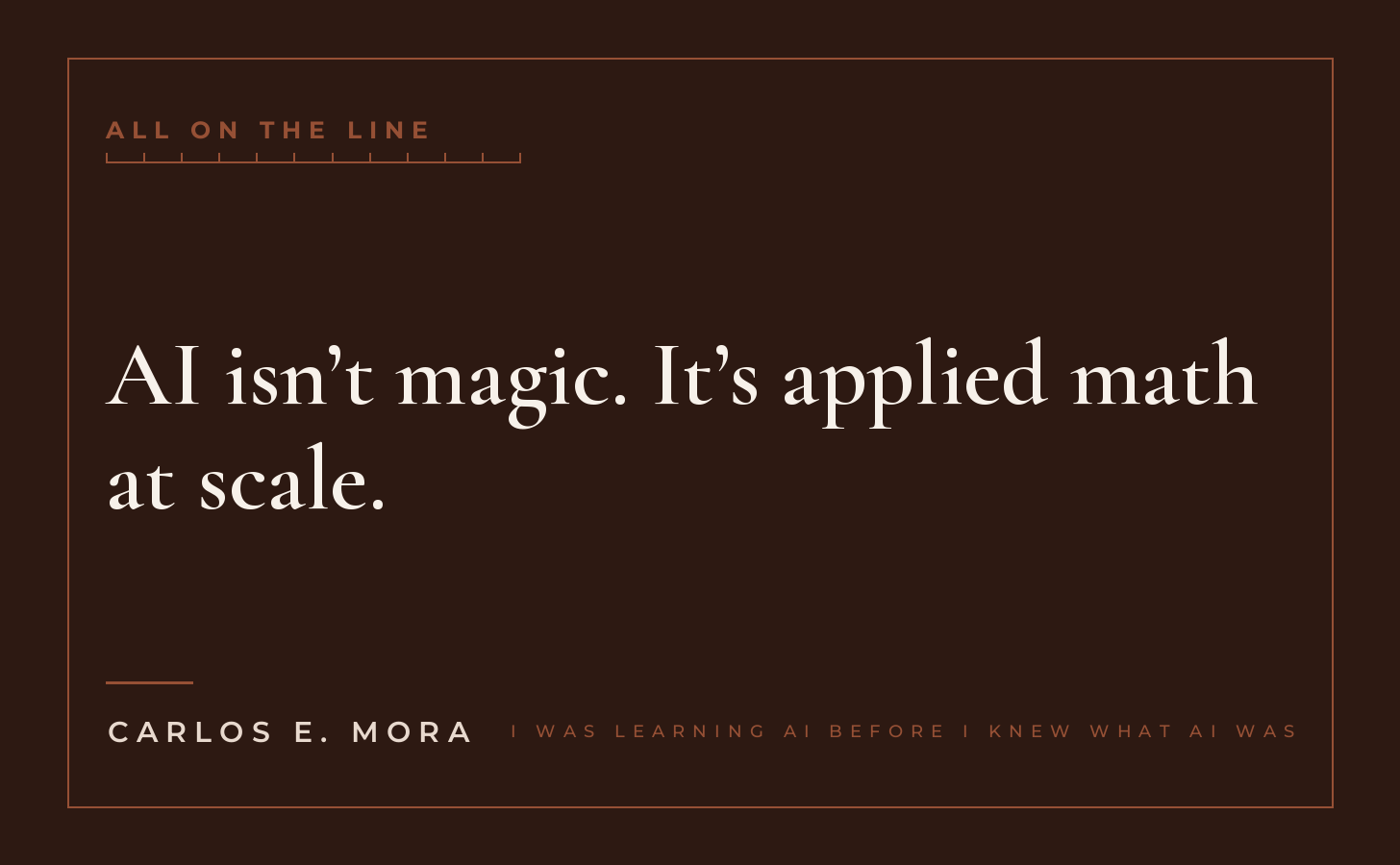
Recently, I took a course on the use of AI in business. What I found most surprising was how mathematical it felt. Yes, there was code. Yes, there were new terms. But at the core, it was optimization. Models trying to predict, organize, and solve with the best outcome in mind. It reminded me that AI isn’t magic. It’s applied math at scale.
As someone who spent years thinking in variables, probabilities, and systems of equations, this was comforting. I didn’t need to know the latest Python framework to understand what was happening. I could understand the logic, the structure, and that gave me confidence, not just in using AI but in contributing to it.
Even today’s large language models, the kind powering tools like ChatGPT, are ultimately grounded in advanced probability, linear algebra, and optimization techniques. Machine learning may seem like a futuristic leap, but at its heart, it’s an extension of the same mathematical logic I studied two decades ago.
I’ve always thought of mathematicians not as specialists in one instrument, but as orchestra directors. We may not write every line of code, but we understand how each piece should come together, how the frontend interacts with the data model, how incentives shape outcomes, how user behavior reshapes the system over time. We can ask the right questions, see the blind spots, and design systems that are coherent, scalable, and effective. That’s our superpower.
In an era where technology is moving faster than ever, that kind of thinking is invaluable. The ability to abstract, model, and reason across disciplines is exactly what the future needs. And that’s why I’m so grateful I studied mathematics. Not because it taught me the tools of today, but because it gave me the mindset to learn and build for tomorrow.
— Carlos E. Mora
I wake up, I build, I repeat. No guarantees.
I work like it’s all on the line, because it is.
Family is the only true legacy.
Your name is your currency, and it must be earned daily.
The arithmetic in these essays is the arithmetic the practice runs on a mandate.
Discuss a mandate →