All on the Line · Notes from the Builder
Imagine being tasked with leading the fintech strategy at one of the largest banks in the country. It looked like a dream setup.
Building inside institutions
2 July 2025
5 minutes
Imagine being tasked with leading the fintech strategy at one of the largest banks in the country, with every tool at your disposal. A vast small and medium businesses (SMB) network ready to be served. Entire departments, engineering, design, data, sales, risk, collections, compliance, technically available to support you. Generous seed capital. And even the option to spin out a new company outside the bank’s regulatory perimeter.
But institutions don’t move just because the pieces are there. In large, layered systems, alignment isn’t implied, it has to be orchestrated. Especially when trust, influence, and competing priorities are already baked into the structure.
As someone who had built startups before, I was stunned. You don’t get this kind of launchpad in the wild: you don’t get cheap customer acquisition, you don’t get internal infrastructure, and you definitely don’t get institutional backing. From the outside, it looked like a dream setup.
I was the only full-time person in this new company. No one reported to me. Yet I needed to align more than 10 departments, most of which had never worked together, to build two completely new platforms: a Buy Now, Pay Later (BNPL) product and a Merchant Cash Advance business.
These weren’t junior teams, they were senior stakeholders with their own KPIs, agendas, and timelines. I wasn’t just launching a product, I was engineering alignment across silos, building credibility where none existed, and creating shared traction without formal authority.
Our BNPL platform allowed individual customers to pay in interest-free installments, both online and in physical stores, integrating directly into merchants’ checkouts and offering seamless onboarding and affordability checks. Our Merchant Cash Advance product, on the other hand, enabled SMBs to receive upfront capital based on their POS transaction volume, with repayments made automatically through future sales, ideal for businesses with uneven cash flow.
I had to design the architecture, shape the credit policy, build dashboards and reporting, educate the sales force, get marketing on board, coordinate compliance, legal, data, and engineering, manage product rollout and national scaling, and own the full budget and make all business and financial projections.
And since this was a standalone entity, I had to present quarterly to a board of directors composed of some of the most senior figures inside the bank. It was just me at the head of the table, no team, no buffer. Each quarter, I had to explain what had gone right, what needed to change, and why certain delays had happened.
These weren’t casual updates. They were board-level operating reviews, where outcomes had to be measurable, roadmaps defensible, and signals clear. I learned to treat executive trust as infrastructure, built through precision as well as persuasion.
Despite all the internal friction, we delivered. We built both products, we launched them, we scaled them nationally, and we made them work for the bank, and more importantly, for the SMBs who used them.
The hardest problems weren’t technical, they were human. I wasn’t fighting complexity, I was fighting inertia: teams didn’t trust each other, there was no shared language or metrics, and everyone wanted visibility, but no one wanted ownership.
What I was really doing wasn’t project management, it was executive engagement. I had to translate technical complexity into strategic clarity, and hold space for competing truths until we could design systems people could believe in.
As an entrepreneur, I was used to moving fast and breaking things. As an intrapreneur, I had to move slowly enough to keep everyone on board, but fast enough to keep momentum alive. And perhaps most importantly, I became a manager of internal stakeholders, not junior contributors, but senior leaders, department heads, and managing directors. I wasn’t just handling external merchants or borrowers, I was steering the expectations and priorities of some of the most powerful people inside the bank. Some days I was writing go-to-market (GTM) playbooks, other days I was defending risk models to internal auditors or explaining the revenue potential to skeptical directors.
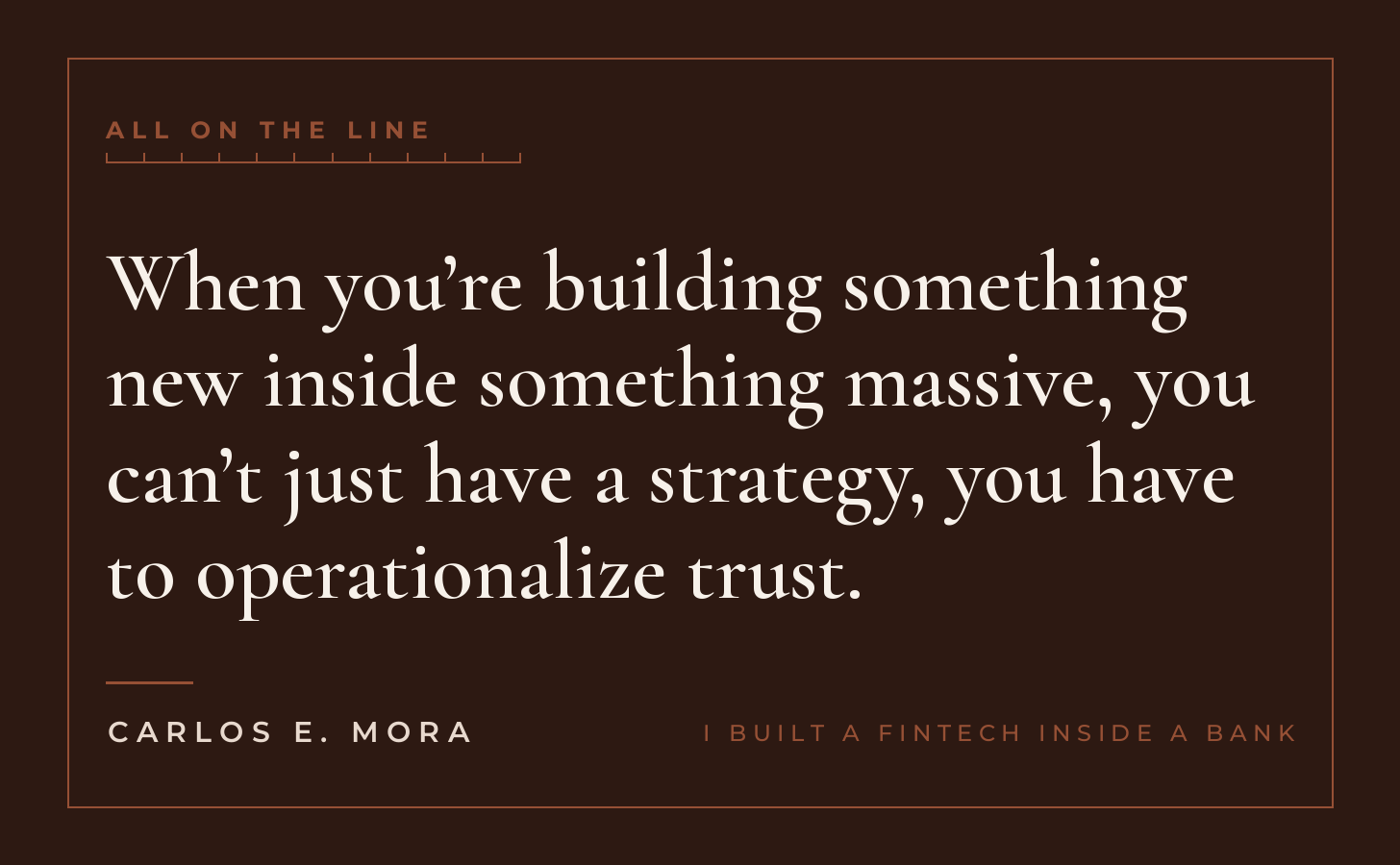
If I had to do it again, I wouldn’t just push for alignment, I’d build the structure for it from day one. I’d codify accountability early, and create shared dashboards everyone trusts. I’d map out the territory, not just the product roadmap, but the influence map. I’d spend less time trying to convince and more time designing systems that compel action by default. Because when you’re building something new inside something massive, you can’t just have a strategy, you have to operationalize trust.
And beyond the systems and the structure, I’d remember the personal side: the resilience it took to show up every day, lead without a title, take hits without flinching, and never let the mission fade. That’s the unspoken part of this kind of work, the stamina to keep moving when nothing moves with you.
That’s what I carry forward: not just the scars of having done it, but the clarity to do it better, with more structure, more speed, and more trust. Resilience isn’t something I talk about. It’s something I’ve operationalized, in the boardroom, across functions, under pressure. That’s what real operations leadership requires.
— Carlos E. Mora
I wake up, I build, I repeat. No guarantees.
I work like it’s all on the line, because it is.
Family is the only true legacy.
Your name is your currency, and it must be earned daily.
The arithmetic in these essays is the arithmetic the practice runs on a mandate.
Discuss a mandate →