All on the Line · Credit and Financial Architecture
Mexico's digital finance is loud but fragmented. This column uses an orchestra metaphor to show why a national framework is urgently needed.
Digital finance in Mexico
23 September 2025
9 minutes
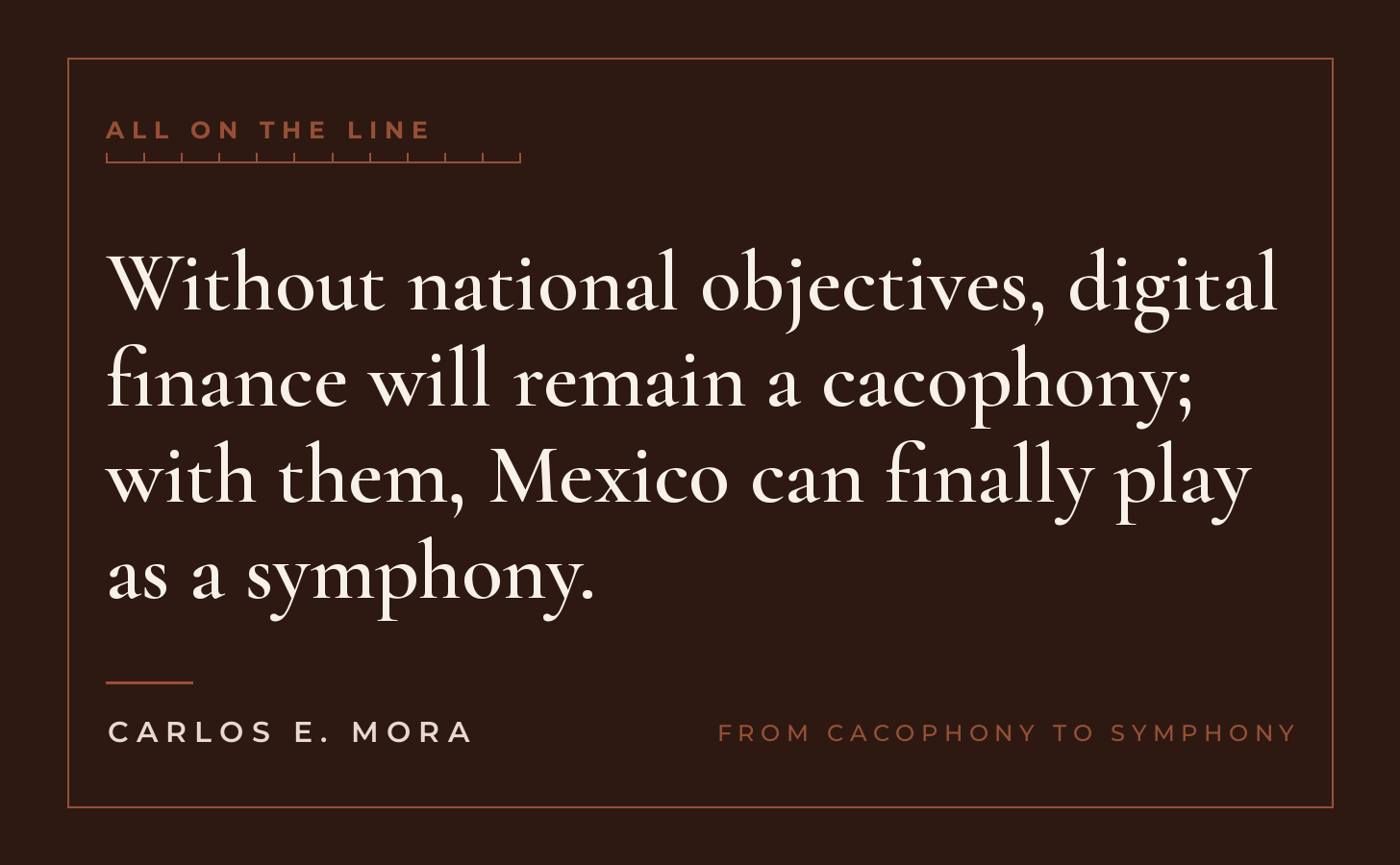
Mexico’s financial system today resembles an orchestra without a conductor. Each section is playing a different score, at a different rhythm, competing to be heard over the rest. The brass and percussion are the digital banks and fintechs, blowing their trumpets and banging their drums with enormous force, powered by investor money and the conviction that sheer volume will guarantee survival. Nu, with its seemingly endless lung capacity, can keep blasting its notes while others around it fall silent. The strings are the incumbents, the large banks that have been seated for generations. They play with discipline but little flexibility, repeating the same patterns, charging for every note, refusing to adapt their tempo even as the music around them changes. Outside the hall stand Visa and Mastercard, not even performing but selling the sheet music at a steep price to anyone who wants to join in, ensuring that participation itself comes at a cost. And then there are the woodwinds, the innovators, subtle, melodic, full of potential to enrich the sound, but their delicate notes are drowned out in the cacophony, and too often they fall silent before the audience even hears them.
What should be a symphony of inclusion and digital progress has instead become noise. Dozens of digital banks and fintechs fight for market share, but none know what the final score is meant to sound like. They copy one another, driven by FOMO and not by purpose, burning through capital without clarity on how to build sustainable businesses. The incumbents continue to profit handsomely from some of the highest fees in the world, while the newcomers, despite their energy, often rely on high-interest products that exclude rather than include. And in the middle of all this noise, the audience, the Mexican public, still waits for access to what really matters: credit that builds rather than destroys, and payments that make life easier rather than more expensive.
Without a conductor to set the tempo, and without a score that defines what harmony should sound like, the orchestra will never produce music worth listening to. Mexico’s digital finance will remain a collection of disconnected experiments, loud solos, and frustrated innovators. And the cost of this cacophony will be paid not by the players, but by the citizens left waiting in silence for a song that never comes.
An orchestra without a conductor is destined to remain in disarray. No matter how much talent sits on the stage, no matter how expensive the instruments, without someone to set the tempo and without a score that defines the melody, the music will never rise above noise. Mexico’s digital finance is in precisely this position. We have the musicians: global fintechs, local startups, century-old banks, technology providers, payment networks. We have the instruments: mobile apps, debit cards, credit products, QR codes, biometric systems. And we have the audience: a population eager for access, for credit that enables and payments that simplify. What we lack is the conductor and the score, a framework that tells everyone where we are headed, and how we intend to get there.
That framework cannot be vague. It must establish national objectives in fintech, digitalization, and inclusion. Without them, we will continue to add players to the orchestra, but never achieve harmony. Mexico needs to define where it wants to be in five, ten years. What share of payments should be digital? How much of today’s reliance on cash should disappear? How many SMEs should have access to affordable working capital, not at usurious rates but on terms that allow them to grow? How much should transaction fees fall, so that payments become a tool for inclusion instead of a toll booth for intermediaries?
These are not rhetorical questions. They are the score that must be written before the orchestra can play. Every successful national digital strategy, whether in payments, credit, or identity, has been built around clear targets that align government, regulators, incumbents, and innovators. Without those targets, Mexico will continue to drift, hoping that somehow the musicians tune themselves to one another. But orchestras don’t work that way. Someone has to step forward with the baton, place the score in front of every musician, and demand that they follow it. Only then can the music begin.
Once the score is placed in front of the orchestra, the question becomes: what should it say? What are the essential notes, rhythms, and harmonies that would allow Mexico’s financial system to play in unison rather than in conflict? The answer lies in a handful of elements that, taken together, can transform noise into music.
Credit is the melody that people carry with them when they leave the concert hall. If it lifts them, they will hum it on the way home; if it fails, they will never return. Too often in Mexico, credit has been written in a minor key, structured in ways that trap families and businesses, not free them. As I have argued before, we are lending people into poverty and calling it progress. A framework must ensure that lending aligns incentives: that banks and fintechs succeed only when borrowers succeed. Credit should be constructive, not destructive, and the melody should inspire trust rather than fear.
If credit is melody, payments are rhythm. They keep the entire orchestra moving forward. And yet in Mexico, rhythm is fractured. Every bank, every fintech, every intermediary sets its own beat, charging tolls at every measure. The result is syncopation that confuses the players and frustrates the audience. A national framework must establish payments as interoperable, affordable, and seamless. The rhythm section cannot be left to those selling sheet music at the door, charging whatever they like for others to join in. If the beat is fair and steady, the rest of the music can flourish.
No orchestra wins applause without harmony. It is what makes the whole greater than the sum of the parts. In finance, harmony means trust. It means people believing that the system will not exploit them, that rules will be applied fairly, and that their identities and transactions will be secure. Mexico’s recent scandals have only underscored how fragile this harmony can be. A framework must make trust a national priority, through a robust digital identity system, through interbank direct debit that actually works across all banks without friction, so that citizens can authorize payments or loan repayments with confidence, and through transparency that reassures the public. Without harmony, the audience will walk out.
Every musician relies on the same score to stay aligned. Without it, chaos ensues. In today’s financial world, that score is data. But data alone is not enough; it must be interpreted in real time, anticipating risks and guiding behavior. Artificial intelligence can be the conductor’s assistant: predicting who will pay, routing loans to the right borrowers, and monitoring systemic risk before it becomes a crisis. If Mexico does not invest in this layer, it will forever play blind, with each musician improvising their own notes. The score must be written, shared, and intelligently read.
No orchestra performance is complete without soloists who bring life and character to the music. In Mexico, those soloists are the small and medium businesses, the engine of the economy. And yet too often, they are given broken instruments and no chance to shine. A national framework must ensure that SMEs have access to credit, digital tools, and payment systems tailored to their reality. If the soloists cannot perform, the orchestra loses its vitality.
These elements, melody, rhythm, harmony, score, and soloists, are not abstract. They are the pillars of a framework that Mexico urgently needs. Without them, the orchestra will remain fragmented, no matter how many new musicians join the stage. With them, the possibility of a true symphony emerges.
Mexico is not the first country to wrestle with financial cacophony. Around the world, some orchestras have found their conductor and score, while others have let the noise drown out the music. The contrast is instructive.
In 2016, India introduced the Unified Payments Interface, or UPI, a national payments framework designed not to favor one instrument over another, but to unify them into a single performance. UPI set clear objectives: instant transfers, interoperability across all banks and wallets, and zero fees for basic payments. The conductor raised the baton, the tempo was set, and suddenly every musician in India’s financial orchestra had to follow the same rhythm. The result was extraordinary. By August 2023, UPI processed more than 10 billion transactions in a single month, more than every card network combined. Fintechs thrived not by reinventing payments, but by innovating on top of the shared backbone. Consumers adopted digital payments en masse because they were free, fast, and trustworthy. India’s orchestra learned to play in harmony, and the music could be heard far beyond its borders.
Elsewhere, the absence of a conductor produced the opposite result. In Kenya, M-Pesa’s early success was celebrated worldwide, but without a framework for credit, interoperability, and consumer protection, dozens of copycat apps flooded the market. Many offered predatory loans at triple-digit interest rates. Defaults surged, trust collapsed, and regulators were forced to step in after the damage was done. Nigeria faced a similar fate with mobile money and digital banks: too many players, too little coordination, and too much reliance on short-term, high-cost lending. The music started with promise but devolved into noise, leaving the audience disillusioned.
Mexico today stands between these two paths. We have the energy and the instruments, but no conductor and no score. We can either follow India’s example, aligning on a framework that reduces fees, builds trust, and opens credit responsibly. Or we can drift toward the Kenyan and Nigerian experience, multiplying apps and accounts while trust erodes and defaults rise. The lesson is clear: without national objectives, the orchestra will keep playing out of tune, and the audience will walk away.
Every orchestra, even one without a conductor, has winners and losers. In Mexico’s financial cacophony, the winners are clear: the incumbents who have been playing the same notes for decades. Large banks continue to charge some of the highest fees in the world, profiting from their control of the strings section. Visa and Mastercard sell sheet music at a premium, earning billions while adding little innovation of their own. Their music may be monotonous, but it is profitable, and so they keep playing it.
The losers are equally clear. Fintechs and digital banks, despite their energy and ambition, struggle to find viable business models. They blast their trumpets, burn through investor cash, and offer free accounts or high-interest products in a desperate attempt to stay on stage. Many fade out before the audience even notices them. The innovators who could enrich the orchestra, those with ideas to reduce friction in payments or expand credit access responsibly, cannot be heard over the noise.
And then there is the public, the audience sitting in the hall. They are promised a concert of inclusion and progress, but what they hear is discord. They face credit that too often destroys rather than builds, payments that are more expensive than cash, and a system that still excludes millions. They pay the price of the cacophony, while the loudest instruments and the sheet-music sellers keep collecting their share.
A national framework would flip this dynamic. The public would finally benefit, with affordable payments, accessible credit, and a system they can trust. Innovators would have a fighting chance, building sustainable businesses on top of a shared backbone rather than fighting one another in isolation. Even the incumbents, though forced to adapt, would continue to profit, but fairly, as part of a symphony rather than a solo act. The music would no longer serve only those on stage; it would resonate with the entire audience.
Mexico has the musicians. We have the talent, the instruments, and the audience ready to listen. What we lack is the score and the conductor. Without them, the brass will keep blaring, the strings will keep repeating old notes, the sheet-music sellers will keep raising their prices, and the woodwinds will eventually give up, drowned in noise. The result will remain what it has been for years: a cacophony of apps, accounts, and cards, each promising change, none delivering it.
But with a framework, the story can change. Imagine an orchestra where the melody of credit builds people up instead of tearing them down, where the rhythm of payments is steady, fair, and accessible to all, where harmony is restored through trust in identity and institutions, where the score, the data, is shared and intelligently interpreted, and where the soloists, the SMBs, are given the spotlight they deserve.
This is not just about fintech. It is about the financial backbone of the country, the system that determines whether citizens and businesses can grow, whether cash finally gives way to digital, whether trust replaces suspicion. Mexico is at a crossroads. We can remain in cacophony, where only the loudest survive and the rest fade away. Or we can lift the baton, set the tempo, and write the score that turns noise into music.
That is not wishful thinking. It is the natural result of aligning the players under a single vision, of setting national objectives that cannot be ignored or delayed. The time has come for Mexico to play as a symphony in digital finance.
— Carlos E. Mora
I wake up, I build, I repeat. No guarantees.
I work like it’s all on the line, because it is.
Family is the only true legacy.
Your name is your currency, and it must be earned daily.
The arithmetic in these essays is the arithmetic the practice runs on a mandate.
Discuss a mandate →