All on the Line · Credit and Financial Architecture
Financial markets have evolved from exclusive clubs into the most democratic wealth-building system in history. Here's how ordinary investors became its center of gravity.
Access to capital markets
26 November 2025
8 minutes
Financial markets stretch back more than four centuries, and their story begins not with a romantic ideal of shared prosperity but with highly selective access. The Amsterdam Stock Exchange, widely considered the first modern exchange, was founded in 1602 as part of the Dutch East India Company’s effort to finance global trade. London followed with its own formal exchange in 1698, though active stockjobbing in London coffeehouses had been alive for decades before that. These early markets were revolutionary in concept yet narrow in practice: participation flowed through merchant guilds, wealthy trading families, royal charters, and networks of insiders who lived close to the centers of commerce and power. The idea that an ordinary worker could own a piece of a major enterprise simply wasn’t part of the social imagination.
As the United States industrialized in the 19th century, the mechanics of public ownership became more visible. Railroads, banks, steel companies, and utilities issued shares to raise capital, but “public” in this context should be understood carefully. The New York Stock Exchange was founded in 1792, yet meaningful public participation did not begin until the late 1800s, and even then access did not translate into fairness. Corporate disclosures were inconsistent or nonexistent, insider trading was not illegal (and would not be regulated until 1934), and price manipulation was rampant because it was neither explicitly forbidden nor culturally frowned upon. Financier syndicates could inflate, suppress, or corner a stock with little risk of punishment. What we would now call fraud was often described then as “astute operator behavior.”
This is why market manipulation wasn’t an aberration, it was simply how the game was played. There were no mandatory audited financial statements until the Securities Act of 1933, no regulatory body to oversee markets until the SEC was created in 1934, and no meaningful protections for retail investors until after the Wall Street crash of 1929 exposed the system’s structural fragility. Insiders exited early, brokers sold speculative issues to retail investors without understanding the risks themselves, and companies overstated earnings, understated debt, and operated under fragmented rules that varied wildly from firm to firm. Ordinary people lost their savings not just because markets fell but because they had been invited into a game designed without their safety in mind. For decades, markets functioned like a private theater: outsiders could buy a ticket, but the script, the lighting, and the exits were controlled by the people on stage.
It took the reforms of the 1930s, through mandatory disclosures, standardized accounting, insider-trading rules, and regulated exchanges, to begin shifting financial markets toward something resembling a shared platform. And even with these protections in place, true democratization was still half a century away. There was nothing preordained about low-cost index funds, fractional shares, robo-advisors, or global diversification. None of this existed before the 1970s, and much of it emerged accidentally, from innovation, competition, regulation, and the slow cultural recognition that broad access to capital markets was not only possible but socially beneficial. The system we now take for granted was not built by destiny; it was built by design, decade after decade.
For most of the last four hundred years, financial markets were structured for the few. The fact that they now function for the many is one of the great, underappreciated shifts in modern economic life.
By the middle of the 20th century, the architecture of American finance began to shift in ways that made markets more accessible, yet still far from fair. The rise of employer pensions in the 1940s and 1950s created the first real link between ordinary workers and the stock market, though this link was mediated entirely through large institutions whose decisions were opaque and whose incentives were often misaligned with the people they were meant to serve. Mutual funds gained traction in the postwar decades, offering a new form of pooled investment, but high fees, limited transparency, and a culture of active stock picking meant that even this expanded access came at a steep cost.
Throughout the 1950s, 1960s, and into the 1970s, the public could invest directly in stocks, yet barriers remained everywhere. Brokerage commissions were fixed and expensive, meaning that buying or selling a single stock could cost the equivalent of hundreds of dollars in today’s terms. Financial information reached the public slowly, filtered through newspapers, newsletters, and brokers whose research was shaped by their own firm’s interests. Mutual funds charged annual fees that routinely reached two or three percent, a burden that quietly ate into returns and ensured that professional managers captured a disproportionate share of the gains.
The system was opening, but the odds remained uneven. The person saving for retirement in 1975 was more connected to capital markets than their grandparents, yet they still had little control over costs, little visibility into the quality of available products, and little protection from a financial industry that thrived on complexity and the mystique of expertise. Access had expanded, but it expanded unevenly, and the result was participation that remained structurally tilted toward institutions and intermediaries.
This was the first era in which ordinary people could claim a seat in the financial system, but it was a seat placed at the far end of the table, where the view was limited and the rules were made elsewhere.
The transformation that began in the late 20th century accelerated with remarkable speed once technology, regulation, and competition converged, creating an environment in which investing finally became a practical reality for the many rather than a privilege reserved for the few. The introduction of index funds in the 1970s, an innovation that initially attracted little attention, quietly rewired the economics of investing by challenging the idea that superior stock picking justified high fees. As these funds grew, they placed enormous pressure on traditional active managers and began to shift trillions of dollars toward low-cost, diversified exposure that required no specialized knowledge and offered something close to market-level returns with minimal friction.
By the 1990s and early 2000s, online brokerages, the expansion of 401(k) plans, and a more transparent regulatory climate reshaped the experience of ordinary investors. Opening an investment account, once a bureaucratic and expensive process, could be done from a home computer and later from a smartphone. Brokerage commissions, once fixed and onerous, began their descent toward zero. Information that had previously been slow to reach the public, corporate filings and real-time quotes, became widely available, eroding the asymmetry that had defined earlier decades.
In this period, mutual funds and especially ETFs became the vehicles through which millions of workers gained exposure to the stock market. A schoolteacher or factory worker contributing to a retirement plan could, perhaps for the first time in history, access a globally diversified portfolio without navigating opaque fees or proprietary products. The market, which had been an elite domain for centuries, became something that lived in the pockets and paychecks of everyday people.
What makes this era distinctive is not merely that access expanded, but that access expanded safely. Costs were low, options broad, protections meaningful. For the first time, the average participant could expect that the structure of the financial system was aligned with their long-term interests. The age of real access had arrived, and with it a revolution in how wealth could be built.
The curious thing about this new era of broad access is that, even as millions now invest through retirement accounts, index funds, and low-cost brokerages, very few see themselves as consequential actors in the financial system. The language of Wall Street still feels distant, the scale of global markets abstract, and the structures through which people invest are so automated and efficient that they recede into the background of life. Yet beneath that sense of distance lies a rarely articulated truth: the small investor is no longer a marginal participant. They are, collectively, the center of gravity.
The trillions of dollars managed by firms like Vanguard, BlackRock, and State Street do not belong to a financial elite; they belong to teachers, firefighters, social workers, engineers, nurses, entrepreneurs, and families who contribute steadily through their retirement plans. When these funds cast votes in corporate elections or pressure companies to improve governance, they act on behalf of millions of ordinary people who may never read a proxy statement. The influence is aggregated, but the ownership is distributed.
This power expresses itself not through dramatic individual decisions but through the quiet weight of collective behavior. Low fees triumphed because retail investors embraced index funds. Opaque, high-cost mutual funds declined because the public refused to subsidize underperformance. Stewardship has become central because asset managers now answer, in effect, to millions of small investors whose savings define the market itself.
The retail investor may not feel like an architect of the financial system, yet the system increasingly bends around their preferences, their contributions, and their insistence, whether conscious or not, on efficiency and fairness. The democratization of access has produced the democratization of influence.
If the last century of financial history was defined by a slow widening of access, the next chapter is shaped by something more ambitious: a system in which the default experience of the ordinary investor becomes both efficient and empowered, not because each person masters financial markets, but because the architecture increasingly aligns incentives with the interests of the people who sustain it. And although democratization of access does not eliminate wealth inequality, it transforms the mechanics of opportunity by making the tools of wealth-building broadly available rather than reserved for the few.
This landscape is taking shape through innovations that are quietly restructuring investor power. Pass-through voting, which allows index-fund investors to influence how their shares are voted, is beginning to break the monopoly of stewardship decisions. Direct indexing, once restricted to the wealthy, is becoming accessible to a broader public, offering the ability to own individual slices of the market while preserving the simplicity of an index fund. And tokenized assets, still more promise than practice, hint at a future in which fractional access extends into corners of the economy that have historically been closed to ordinary investors.
Yet the most important levers remain simple. Choosing low-fee, diversified vehicles preserves more of every dollar invested. Avoiding high-cost, opaque products protects the compounding that ultimately determines long-term wealth. Supporting platforms that prioritize transparency and investor choice strengthens the democratic character of the system. None of these actions require expertise; they require awareness.
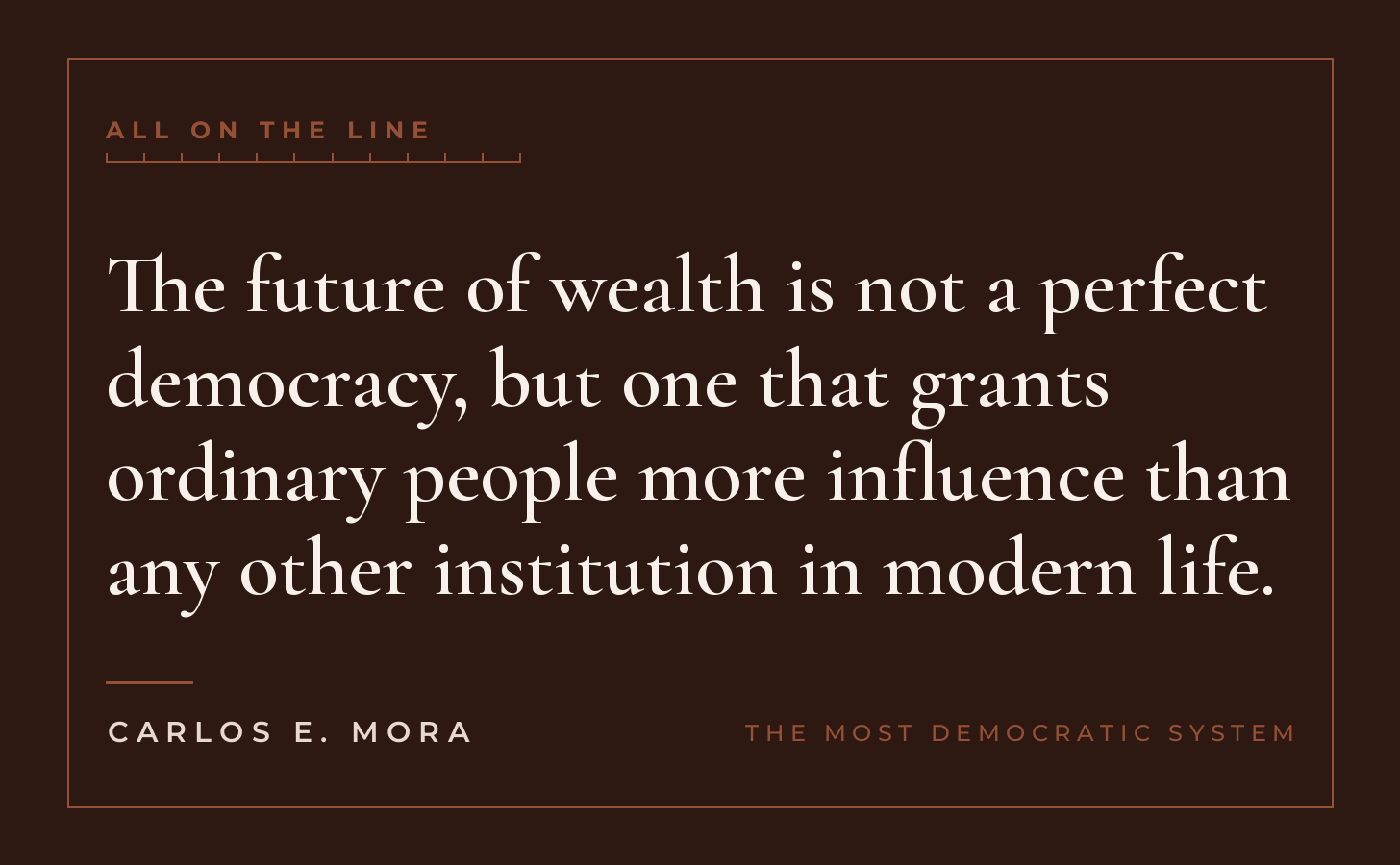
And that may be the final frontier. The structures now exist to make investing fair, accessible, and aligned with the interests of the many. The remaining step is cultural rather than technical: for the average investor to understand that they inhabit a financial world designed not to exclude them but to carry their savings, their preferences, and their quiet collective decisions into the heart of global markets. The future of wealth is not a perfect democracy, but it is becoming a democratic system by design, one that grants ordinary people more influence than they have ever held in markets, in institutions, or in any of the systems that govern modern life.
— Carlos E. Mora
I wake up, I build, I repeat. No guarantees.
I work like it’s all on the line, because it is.
Family is the only true legacy.
Your name is your currency, and it must be earned daily.
The arithmetic in these essays is the arithmetic the practice runs on a mandate.
Discuss a mandate →