All on the Line · Mathematics
Some financial systems behave like heavy-tailed distributions, where rare events dominate and the average may not exist.
Heavy tails
12 March 2026
6 minutes
The average is one of the most widely utilized concepts in statistics: collect many observations, compress them into a single number, and the apparent randomness of individual outcomes reveals an underlying order. If the average temperature in a city is seventy-five degrees, most days will orbit somewhere around that value. If the average exam score in a class is eighty percent, the distribution of results will cluster modestly above and below that center. The average becomes a gravitational point around which reality fluctuates. It promises that beneath the chaos of individual variation lies a stable description of the system.
In many domains this intuition works beautifully because the mathematics cooperates. Human heights cluster tightly around a central value. Measurement errors in engineering follow distributions where large deviations become exponentially unlikely. Manufacturing tolerances drift slightly but rarely catastrophically. In systems like these, the probability of extreme observations declines so rapidly that their contribution to the average becomes negligible. As more observations accumulate, the sample mean converges toward a stable value. The average becomes not merely convenient but meaningful, a reliable summary of the process generating the data.
Because this logic works so well in everyday contexts, we instinctively extend it to far more complicated systems. Businesses forecast average growth rates, investors estimate average returns, economists model representative agents whose behavior stands in for entire populations. The average becomes the lens through which uncertainty is reduced to something intelligible. Faced with a world of innumerable possibilities, the promise of a single stabilizing number becomes irresistible. Yet mathematics offers an unsettling counterexample: an average is not always achievable. Entire families of distributions exist where this comforting property breaks down, where the very concept of an average stops behaving the way our intuition expects. In those systems the average is not merely difficult to estimate or sensitive to the data; mathematics cannot even define one.
The phenomenon emerges from a class of probability distributions known as heavy-tailed distributions. Unlike the familiar bell curve, where extreme outcomes become exponentially rare, heavy-tailed distributions decay much more slowly. Large events still become less likely as they grow in magnitude, but they do not disappear quickly enough to stop influencing the system. The tail of the distribution retains enough probability mass that rare observations remain capable of dominating the overall outcome.
One of the simplest examples is the Pareto distribution, introduced by the Italian economist Vilfredo Pareto while studying the distribution of wealth in nineteenth-century Europe. Pareto noticed that a small fraction of individuals controlled a disproportionate share of economic resources, a pattern that appeared repeatedly across countries and datasets. When he examined the numbers mathematically, he discovered that wealth followed a power-law distribution rather than the tidy bell curve economists often assumed. In a power-law world, large outcomes shrink in frequency only gradually, leaving the tail thick with potential extremes.
The mathematics of the Pareto distribution reveals an important threshold. The expected value of the distribution exists only when the tail parameter exceeds one. Mathematically, the mean of a Pareto distribution is
E[X] = αxm / (α − 1), for α > 1
where xm represents the minimum possible value of the variable and α determines how quickly the probability of extreme outcomes declines. Large values of α mean the tail decays rapidly and extreme events fade quickly; small values of α mean the tail decays slowly and rare events remain influential. When the parameter α > 1, the distribution possesses a finite mean. When α ≤ 1, the expected value diverges and the distribution has no finite mean. In practical terms, the average is not merely hard to calculate; it is mathematically undefined. No matter how many observations are collected, the sample mean never stabilizes because rare extreme events keep dragging it upward. The system contains outcomes so large that they overwhelm the accumulation of ordinary observations. In plain terms, when α ≤ 1 the average does not exist.
An even stranger mathematical region appears when 1 < α < 2. In that interval the average exists, but the variance does not. The distribution has a center, yet its fluctuations are theoretically unbounded because rare extreme observations dominate the variability of the system. Empirical studies of wealth distributions, firm sizes, and financial returns often place real systems somewhere in this peculiar territory where the mean is finite but the variability refuses to behave. The mathematics is not claiming that extreme events occur frequently, but that even rare events can shape the entire structure of a system when their magnitude grows quickly enough.
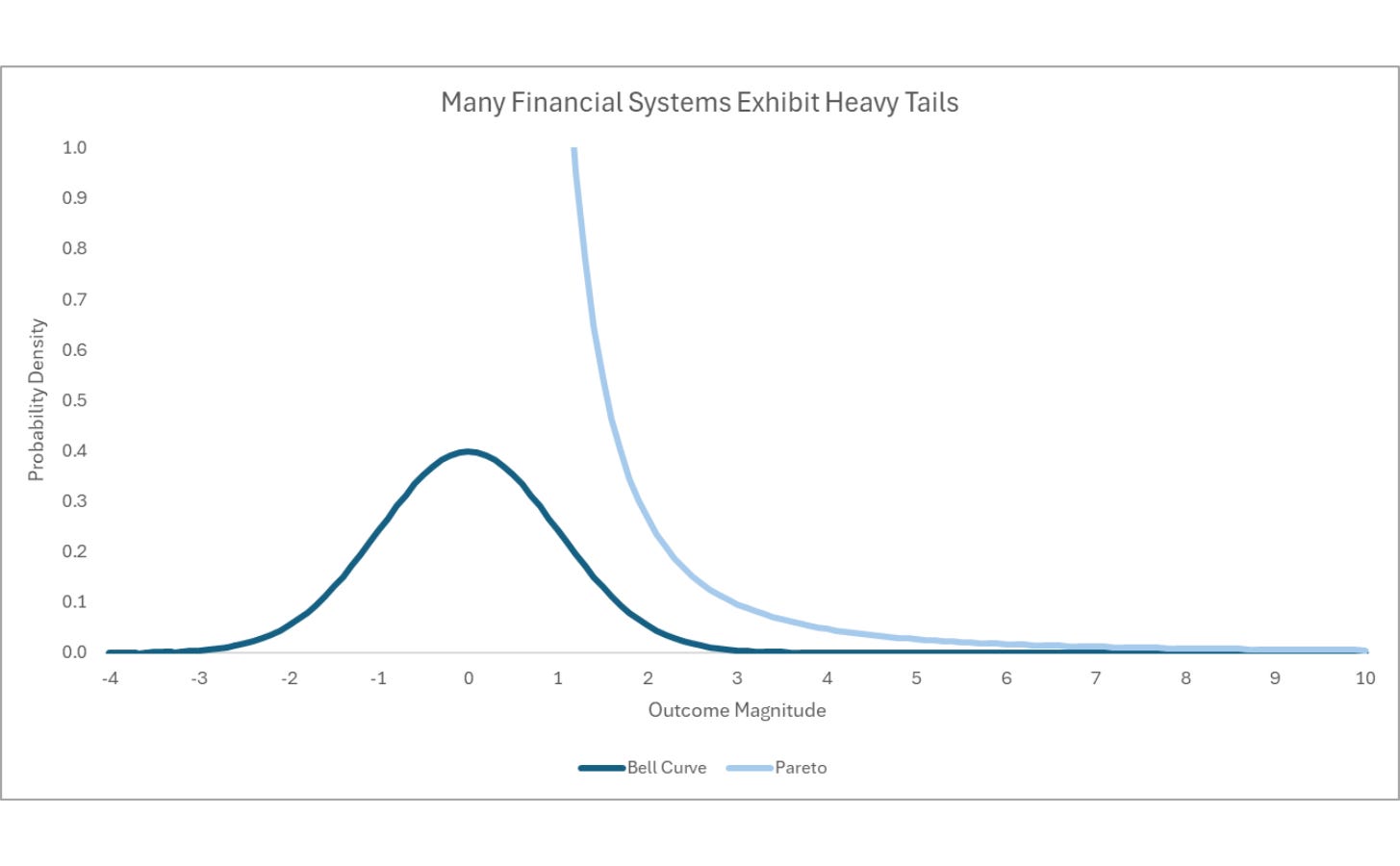
Once this mathematical structure is understood, its fingerprints begin to appear throughout finance. Many financial systems display precisely the asymmetry that Pareto observed in wealth distributions. Most outcomes cluster around mediocrity, while a small number of extreme events dominate the totals. The center of the distribution describes the typical experience, but the tail determines the aggregate result. The parameter α can be understood as a measure of how quickly extreme events fade away. When α is large, the probability of very large outcomes declines rapidly and the system behaves in a familiar way: extreme observations become negligible and averages remain stable. When α is small, the tail decays slowly and rare events remain influential even when they occur infrequently. In that regime the mathematics tells us something profound about financial systems: a handful of extreme outcomes can dominate decades of ordinary activity, and α becomes a measure of how strongly the tail governs the system.
Venture capital offers a vivid example. A typical venture portfolio contains dozens of investments. Most fail outright, a handful produce modest gains, and occasionally one company grows into a global platform business whose valuation dwarfs the rest of the portfolio combined. The distribution of outcomes becomes profoundly skewed: the success of the entire fund depends less on the typical investment than on the rare outlier that succeeds spectacularly. The mathematics of heavy tails explains why the venture industry tolerates such a high rate of failure. In a power-law world, a single extraordinary success can dominate the entire distribution.
Public equity markets display a similar pattern. Research by Hendrik Bessembinder has shown that between 1926 and 2016, just 4% of publicly listed companies in the United States accounted for the entire net wealth created by the stock market. The majority of stocks delivered returns comparable to short-term Treasury bills, and many destroyed value altogether. Yet a small minority of firms generated extraordinary gains that dominated the aggregate outcome. Investors experience the market through the lens of averages and indices, but the long-term wealth creation of the system is driven by a narrow set of extreme winners.
Financial crises follow the same logic. Markets can appear stable for years or even decades, fluctuating comfortably around their expected behavior. Then a rare systemic shock arrives, a sudden collapse in liquidity, a cascading failure of leverage, or a crisis of confidence, and the entire system reorganizes in a matter of days. Decades of calm become historical footnotes compared with the magnitude of the tail event. These episodes reveal the same underlying structure: the system spends most of its time near the center of the distribution, but its defining moments occur far out in the tail.
Seen in this light, the Pareto distribution reveals a third limit in our attempts to model complex systems. Earlier explorations of mathematical structure have shown that combinatorial problems such as the Traveling Salesman explode so quickly that perfect optimization becomes computationally impossible, while Cantor’s work on infinity demonstrates that continuous systems may contain uncountably many possible outcomes. Heavy-tailed distributions introduce a different kind of boundary. Even when we abandon enumeration and compress uncertainty into averages, mathematics may still resist our attempt to summarize the system.
Some distributions are structured in such a way that rare events dominate everything else. In those environments the average either becomes unstable or disappears entirely as a meaningful concept. The center of the distribution exists, but it does not tell the story that determines the system’s fate. The mathematics is not failing; it is revealing that the system cannot be understood by focusing on its typical behavior. Its defining features lie in the extremes.
In finance this insight has practical consequences. If investors optimize portfolios based on average returns, they may miss the rare events that shape long-term outcomes. If risk managers focus on ordinary fluctuations, they may underestimate the shocks that threaten the survival of institutions. Entrepreneurs building venture portfolios quickly learn that success depends less on the median investment than on the extraordinary one that transforms the entire distribution. When systems are governed by heavy tails, the center describes how the system usually behaves, but the tail determines how the story ends.
— Carlos E. Mora
I wake up, I build, I repeat. No guarantees.
I work like it’s all on the line, because it is.
Family is the only true legacy.
Your name is your currency, and it must be earned daily.
The arithmetic in these essays is the arithmetic the practice runs on a mandate.
Discuss a mandate →